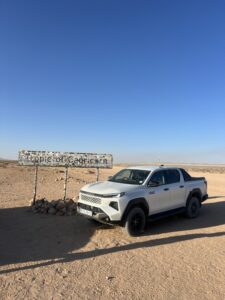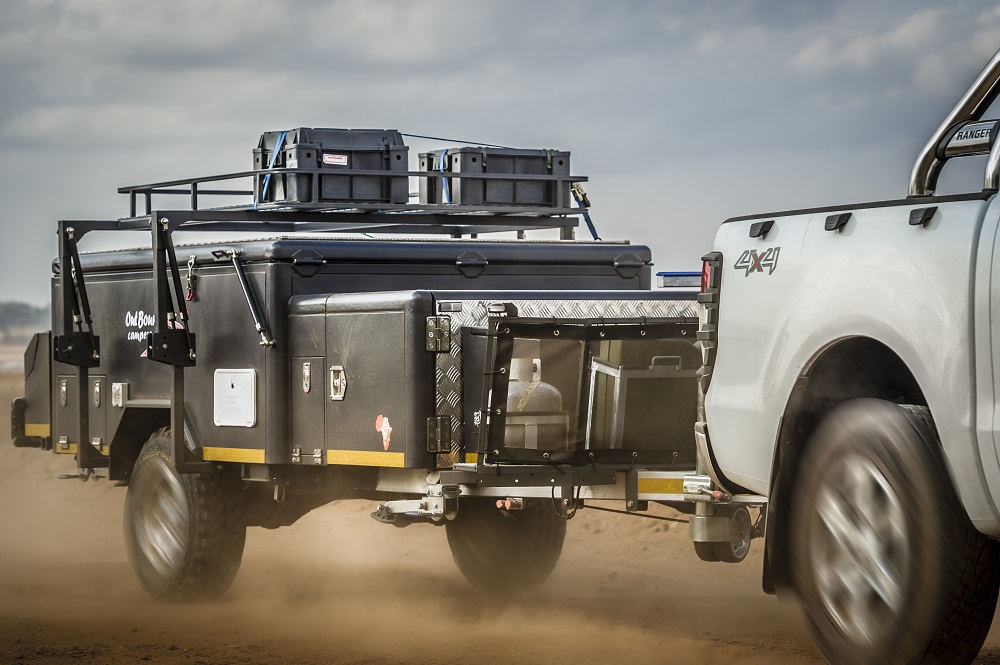
Taking an off-road caravan into the deep bush is the ultimate African overlanding experience. It allows us to carry a slice of comfort into the most remote corners of the continent. Recently, while preparing for a five-day expedition to Nthakeni Bush and River Camp in Limpopo – pairing the highly capable Isuzu M-UX with an Outbound Storm caravan – the intricacies of off-road towing dynamics were brought sharply into focus.
Towing on the tarmac is one thing, but the moment your tyres leave the blacktop, the physics of your vehicle change entirely. An off-road trailer or caravan is not just dead weight; it is an active, dynamic force that influences your braking, steering, and traction. Based on our own time on the trail and countless expeditions, here is the definitive Adventure Afrika guide to mastering off-road towing dynamics.
The Physics of the Hitch: Understanding Your Weights

Before you even turn the ignition, safe off-road towing begins with how your rig is loaded. Ignorance of towing weights is not just illegal; on a steep, rocky incline, it is downright dangerous.

When packing, you need to understand the relationship between your Aggregate Trailer Mass (ATM) and your towball weight. The ATM is the absolute maximum your caravan can legally weigh when fully loaded and unhitched. The towball weight is the downward force exerted on your vehicle’s tow hitch. According to our own trail-tested guidelines, a safe rule of thumb is to keep your towball weight between 7% and 15% of your ATM.
If the towball is too heavy, the caravan acts as a lever, pressing down on your 4×4’s rear suspension and lifting the front wheels. This drastically reduces your steering control and front-wheel traction – a terrifying prospect when navigating a slippery mud track. Conversely, if the towball is too light (often caused by packing heavy items at the rear of the caravan), you create a pendulum effect. This leads to uncontrollable caravan sway at higher speeds and horrific instability on uneven corrugations.
Our Golden Rule for Packing: Always load the heaviest items (like water jerry cans, batteries, and canned food) as low as possible and directly over the caravan’s axles. Distribute remaining lighter gear evenly, ensuring left-to-right balance so one tyre isn’t working harder than the other.
The Rubber Meets the Dirt: Tyre Pressures and Track Width
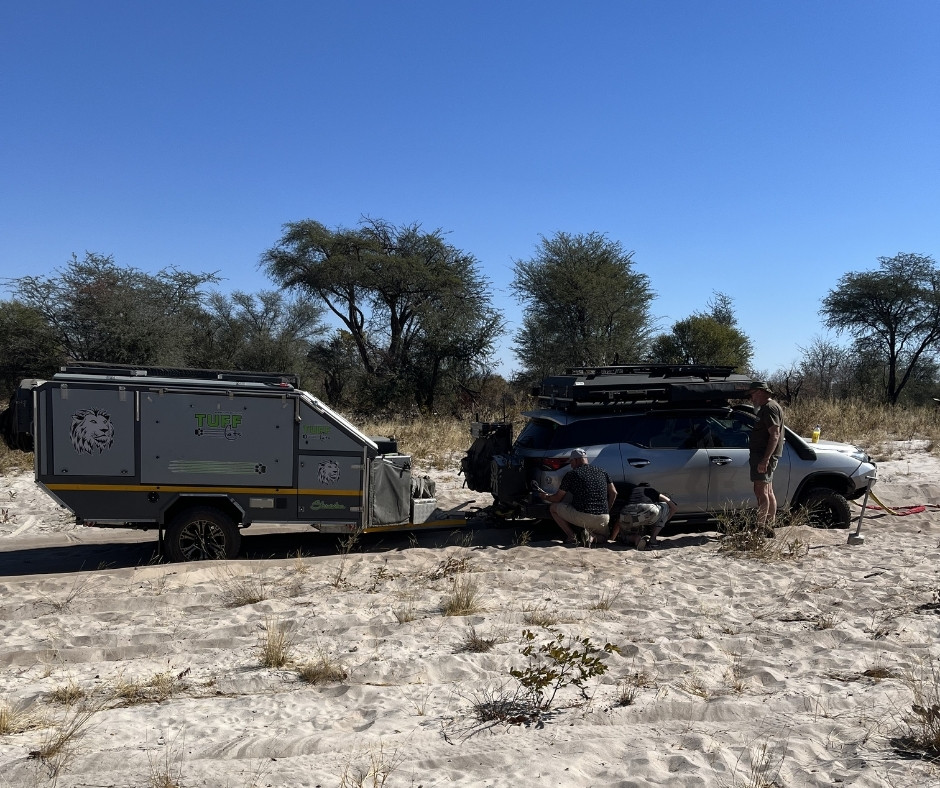
Tyre pressure is your first and most effective line of defence off-road. However, the rules change when you have a couple of tons hitched to your rear bumper.
On the highway, caravan tyres often require higher pressures (typically around 300 kPa depending on the load) to handle the immense weight, while the rear tyres of your tow vehicle should be increased by 30 to 50 kPa to accommodate the downward force of the towball. But off-road, you must let the air out!
Decreasing air pressure lengthens the tyre’s footprint, increasing the surface area in contact with the ground. This reduces rolling resistance, softens the ride to protect your caravan’s chassis from violent vibrations, and most importantly, allows the tyres to float over soft surfaces rather than digging into them.
Furthermore, you must consider wheel track width. Ideally, your caravan should have the exact same track width as your tow vehicle. This allows the trailer’s tyres to roll smoothly into the tracks already compacted by your 4×4. If your caravan has a wider or narrower track, it acts like a plough, constantly forging its own path through sand or mud, multiplying the rolling resistance and forcing your engine to work twice as hard.
Mastering the Sand: The Floatation Game
Sand driving is all about momentum, but a heavy trailer severely complicates the equation. When you hit a patch of thick, soft sand, your caravan instantly becomes a drag anchor.
To counteract this, tyre pressures must drop significantly. Our top tip for sand towing is dropping pressures to around 100 to 150 kPa, depending on your load and the specific conditions. The goal is to keep your rig “skimming” over the surface. If you feel the vehicle starting to get stuck, the worst thing you can do is bury the accelerator. Spinning the wheels will simply dig your 4×4 onto its belly pan.
Side slopes in sandy conditions present a unique and highly dangerous dynamic. When traversing a dune or sandy slope horizontally, gravity pulls the heavy caravan sideways. Because sand offers very little lateral traction, the caravan will naturally want to slide down the slope, pulling the rear of your tow vehicle with it and risking a jackknife situation. If you feel the rear end slipping on a sandy side slope, the only safe recovery method is to immediately turn the steering wheel downhill to drive out of the slide.
Navigating Mud and Ruts
Mud requires a completely different approach. In deep mud, your primary goal is to minimise resistance. The key technique we always advocate is to drive as straight as possible.
If you drive in a straight line, your caravan follows neatly in the ruts created by your tow vehicle. You are only pushing mud out of the way twice (once for the front wheels, once for the rear). However, the moment you steer sharply, your caravan wheels leave your vehicle’s ruts and forge their own. Suddenly, you have six wheels simultaneously pushing heavy, sticky mud out of the way. The rolling resistance skyrockets, and your forward momentum is instantly killed.
Tyre tread also plays a massive role here. While aggressive mud-terrain tyres are excellent on your tow vehicle, fitting them to an off-road trailer is often debated. In heavy, black clay, mud-terrain tyres on a trailer can pack full of mud and fail to clear themselves, adding rotational mass and acting like giant slicks. A high-quality all-terrain tyre is often the better compromise for a trailer, providing enough sidewall strength without turning into heavy mud-donuts.
Rock Crawling, Articulation, and Angles
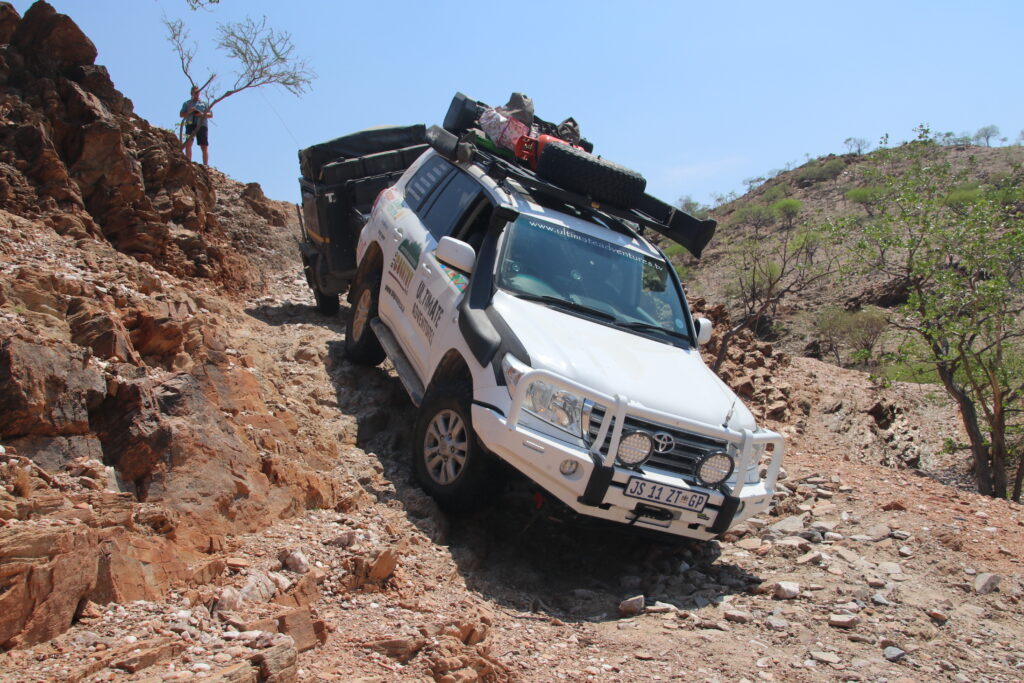
Negotiating rocky escarpments with a trailer demands acute spatial awareness. You must mentally map where all six wheels are at any given moment.
When climbing a rock ledge without a trailer, you typically give the throttle a gentle squeeze to bump the front wheels up, and a second squeeze for the rear. When towing, you must master the “three-squeeze” technique. You need that third, deliberate squeeze of momentum to drag the caravan’s axle up and over the obstacle, right when your tow vehicle is likely sitting at an awkward, traction-limited angle.
This terrain highlights the absolute necessity of a proper off-road hitch. A standard 2-inch tow ball is designed for tarmac; it has a very limited range of articulation. If you drive through a deep donga or over a sharp crest, a standard tow ball will bind. The extreme twisting forces can actually snap the tow ball clean off or bend your chassis. Fully articulated off-road hitches, like heavy-duty poly-block couplings, allow the trailer to roll and pitch independently of the tow vehicle, keeping the connection secure and the chassis stress-free.
You must also be hyper-aware of your caravan’s departure angle. Unlike your 4×4, which sits relatively high, the rear overhang of a caravan is long. When descending steep, rocky drop-offs, the rear of the caravan is highly susceptible to snagging, which can rip off taillights, number plates, or even the rear stabiliser jacks.
Braking and Descents: Managing Overrun Brakes
Gravity is not your friend when towing downhill. A heavy caravan will always try to push your tow vehicle down the slope. Unlike other regions that rely on electric braking systems, our South African off-road caravans almost exclusively use overrun (or inertia) braking systems. Understanding how these engage off-road is critical.
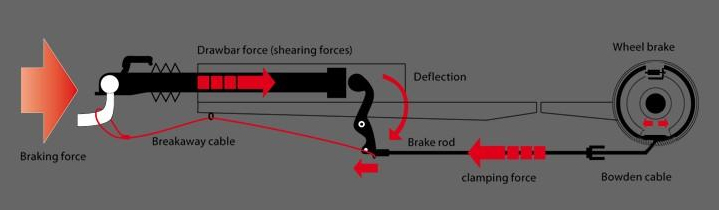
An overrun brake works on a sliding shaft in the hitch. When your tow vehicle slows down, the momentum of the caravan pushes forward against the tow vehicle, compressing the shaft and mechanically applying the trailer’s brakes. On a steep off-road descent, this means your caravan brakes will engage automatically as it pushes against your 4×4.
While this helps keep the rig straight, it presents a challenge on very loose, steep gravel. If the descent is sharp enough, the caravan’s brakes might lock up the trailer wheels entirely. A locked wheel has zero lateral grip, meaning the rear of the caravan could easily slide sideways, causing a jackknife.
To manage this, engine braking is your absolute best tool. Drop your vehicle into low-range first gear before you crest the hill. Let the gearing do the work to keep your speed to an absolute crawl, allowing the trailer’s overrun brakes to engage gently without locking up. If you feel the trailer starting to slide, you may actually need to feather the accelerator very slightly to pull the trailer straight and release the tension on the overrun brake, before slowing down again.
When Momentum Stops: Trailer Recovery Techniques
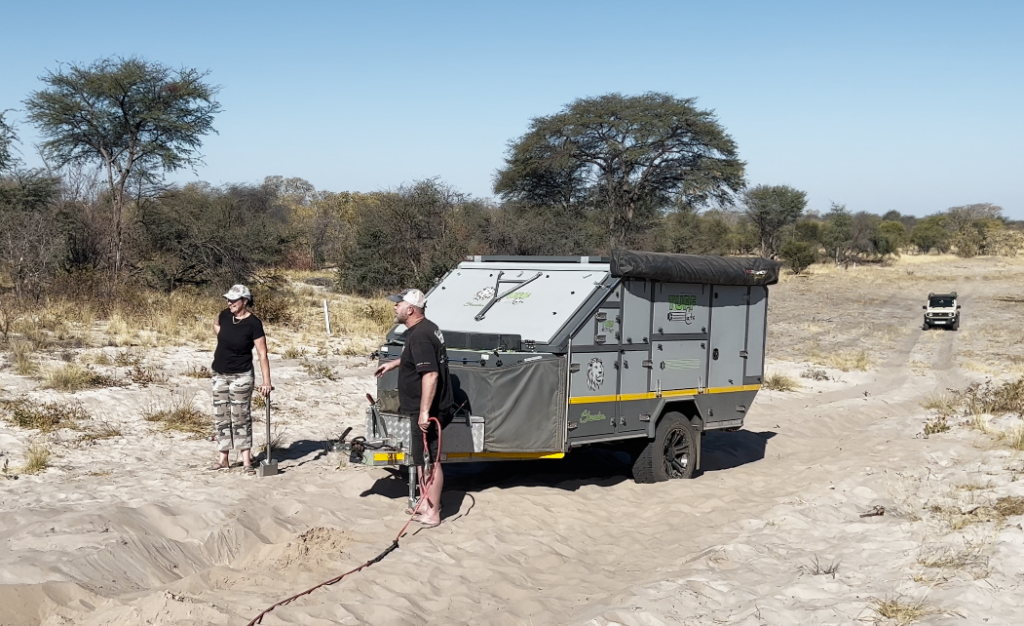
No matter how skilled you are, if you tow off-road long enough, you will eventually get stuck. Recovering a vehicle-and-trailer combination requires extreme caution and specialised techniques.
Your caravan must be fitted with its own rated recovery points on the rear chassis. Never attempt to recover a rig by attaching a kinetic strap to the caravan’s suspension or a flimsy bumper.
If you are deeply bogged in mud or sand, attempting to snatch the entire combination out at once puts monumental stress on both vehicles and the recovery gear. It is often much safer to separate the problem. Chock the trailer wheels, detach the caravan, and recover the tow vehicle first to solid ground. Once the 4×4 is safe, you can use a winch or an extension strap to recover the caravan independently.
For deep sand recoveries, there is a brilliant trick we often use on the trail. If your trailer is bogged, lower the jockey wheel until it protrudes below the chassis, and then slide a sturdy spade or flat shovel directly under the jockey wheel. When you winch or tow the trailer forward, the shovel acts like a ski, allowing the front of the trailer to glide over the soft sand rather than ploughing into it like a bulldozer blade.
The Final Word Off-road towing is an art form that blends physics, mechanics, and patience. It requires you to drive slower, think further ahead, and maintain a constant awareness of the heavy, dynamic footprint following behind you. By mastering your tyre pressures, understanding your overrun brakes, and anticipating how different terrains affect rolling resistance, you can ensure that your rig, your caravan, and your passengers arrive at camp safely – ready to enjoy