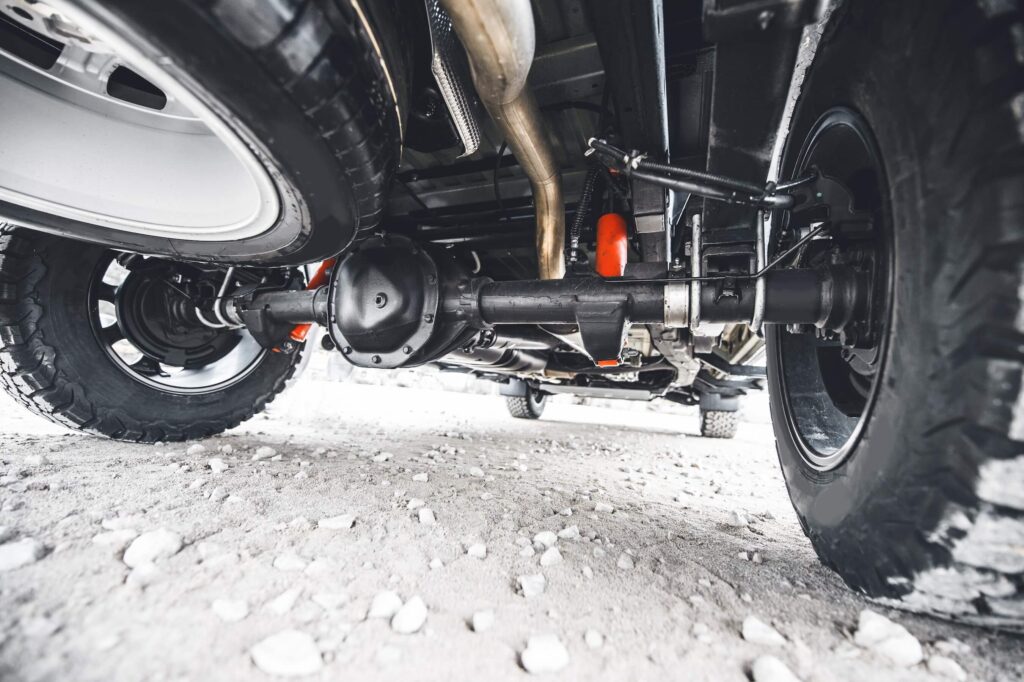
If you own a serious 4×4, you know the frustrating, costly question: “Why does my LT/AT tyre setup constantly vibrate?”
This report presents a comprehensive, data-driven analysis to answer that persistent query. We posit that the vibration issue is not typically a consequence of poor tyre quality but a direct failure of wheel balancing techniques to account for the unique structural properties of off-road tyres. Crucially, it is the method, not the tyre that is inadequate.
We will demonstrate precisely why traditional wheel balancing is fundamentally incapable of eliminating this shudder, identifying road-force balancing as the definitive, necessary solution for these foundational challenges. This resource is intended for a technically literate audience—including professional mechanics, experienced off-road enthusiasts, and fleet managers—seeking the absolute truth about a vibration-free ride.
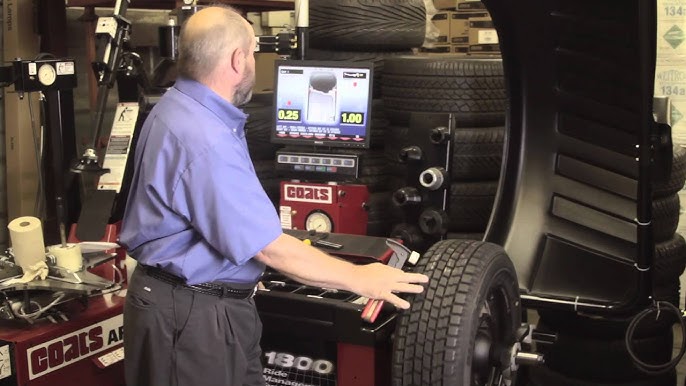
1. Why Correct Tyre Balancing is Critical

Beyond Comfort: The Crucial Importance of Balance
The practice of wheel balancing is an essential maintenance procedure that extends far beyond simply achieving a comfortable ride. It is a critical factor in ensuring vehicle safety, promoting component longevity, and maintaining operational efficiency. When a tyre and wheel assembly is out of balance, it introduces destabilising forces that cascade through a vehicle’s mechanical systems, leading to a range of negative consequences.
The immediate effects of an imbalanced wheel are often felt directly by the driver. These include noticeable vibrations that can be felt in the steering wheel, through the floorboards, or in the seats, especially at specific speed ranges, such as 65–75 mph (100–120 km/h). An imbalance can also cause the vehicle to pull or drift to one side, which requires constant correction and compromises handling and safety. These effects, often referred to as “shimmy” or “tramp,” are particularly pronounced in vehicles with heavy-duty solid axles and complex steering geometry common in serious 4×4 builds.
The long-term consequences are more severe and costly. Continued operation with unbalanced wheels can lead to accelerated and uneven tyre wear, such as tyre cupping or scalloping, which drastically shortens tyre lifespan and increases replacement costs. Furthermore, the unnecessary rolling resistance created by imbalanced wheels forces the engine to work harder, resulting in a measurable reduction in fuel efficiency. Most critically, the constant vibrations transmit stress to essential suspension components, leading to premature wear on shocks, struts, ball joints, and tie rods, which can culminate in expensive, and potentially dangerous, repairs. This constant oscillation rapidly accelerates the degradation of bushings and dampening elements, necessitating premature and costly replacements.
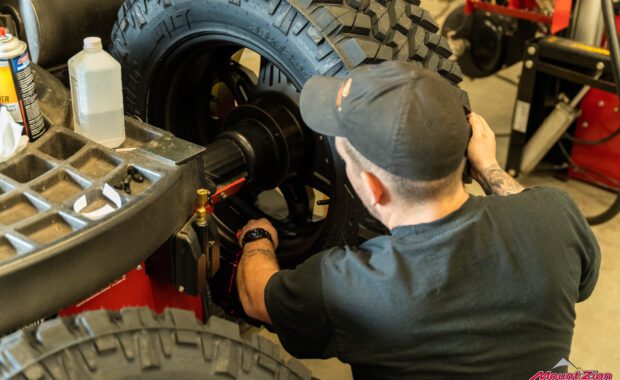
2. The Inherent Challenges of Light Truck All-Terrain Tyres
Weight, Construction, and Tolerance
Light Truck All-Terrain (LT/AT) tyres are engineered for resilience and grip, not necessarily for highway precision. Their fundamental design prioritises robustness and off-road capability, which introduces specific challenges that overwhelm standard balancing equipment.
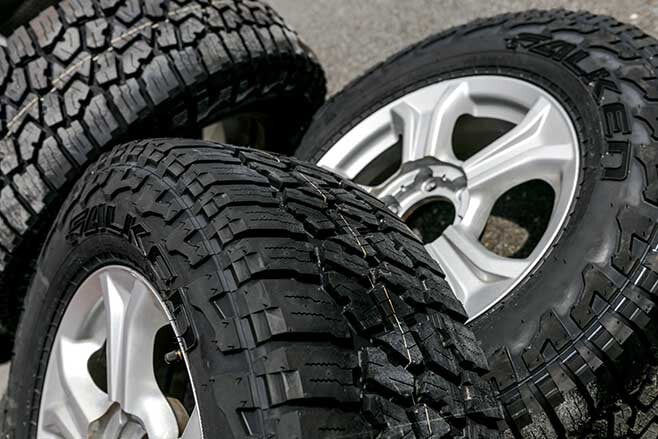
These challenges stem from three inherent characteristics:
Increased Mass and Stiffness: LT/AT tyres feature heavier construction, reinforced sidewalls (often with three-ply designs), and aggressive, thick tread blocks for puncture resistance. This inherent mass creates larger, more pronounced areas of weight variation around the circumference compared to standard passenger tyres. The reinforced sidewalls, essential for airing down on rocky terrain, dramatically increase the tyre’s stiffness, making it less compliant and more prone to transmitting force variations directly into the axle.
Structural Asymmetry (Tread Block Design): The large voids and varied depth of the tread patterns, necessary for mud and rock evacuation, introduce significant dynamic imbalances. The very design that makes the tyre effective off-road, with its non-uniform surface area and material distribution, creates complex vibrational harmonics. As the tyre rotates, the intermittent contact patches and varying deflection of the robust tread blocks result in forces that standard balancers simply cannot predict or measure. This leads to the phenomenon of “ghost vibrations”—a vibration that persists despite the machine indicating a perfect balance.
Manufacturing Tolerances: While modern tyre manufacturing is precise, the complexity of LT/AT construction, combined with the intended off-road use, means manufacturing tolerances for uniformity are broader than those found in high-performance or highway-focused tyres. These minor variations in uniformity become significant vibrational factors at speed. Furthermore, the bead seating area—where the tyre seals against the rim—is often subject to greater variation, which can cause subtle but critical imperfections in the tyre’s rotational centreline.
The Limitations of Standard Dynamic Balancing
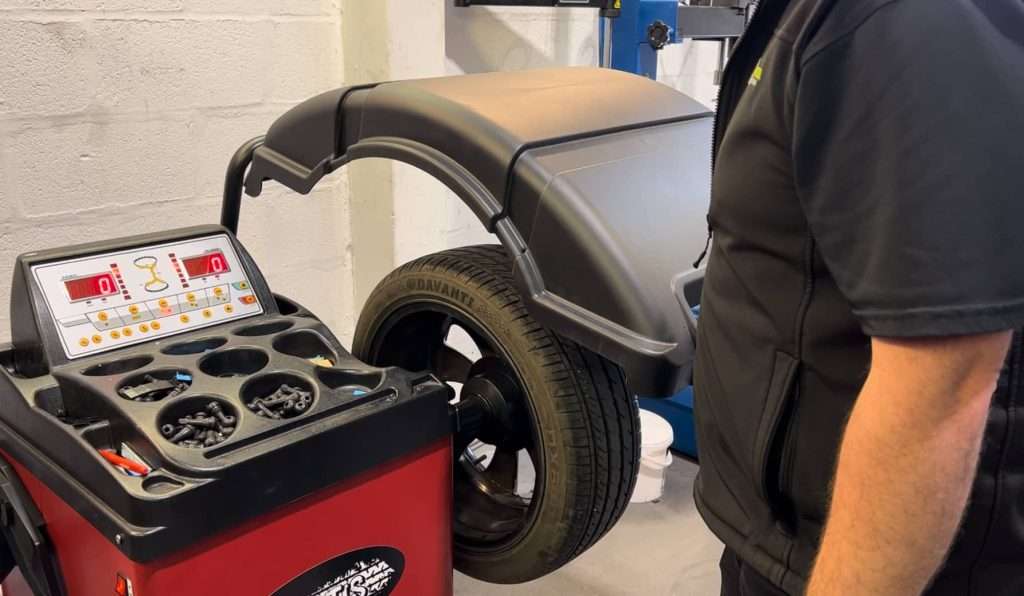
Traditional dynamic balancers operate on the principle of measuring static and couple (dynamic) imbalance. They spin the wheel freely, measure the resulting centrifugal forces, and calculate where to place weights (typically small zinc or lead adhesive or clip-on weights) to ensure the assembly’s centre of gravity aligns with its centre of rotation. This method is highly effective for homogeneous passenger tyres with uniform construction.
However, standard balancing completely ignores two critical factors that are dominant in LT/AT tyre balancing: run-out and stiffness variation.
Radial and Lateral Run-Out (Under No Load): Standard equipment measures run-out (the deviation from a perfect circle or a perfect plane) without applying load. The moment the heavy 4×4 vehicle’s weight compresses the LT/AT tyre, the internal stiffness variations dictate how the tyre deflects against the road. The ’roundness’ measured freely is irrelevant to the ’roundness’ under load, leading to immediate error in the balance prescription.
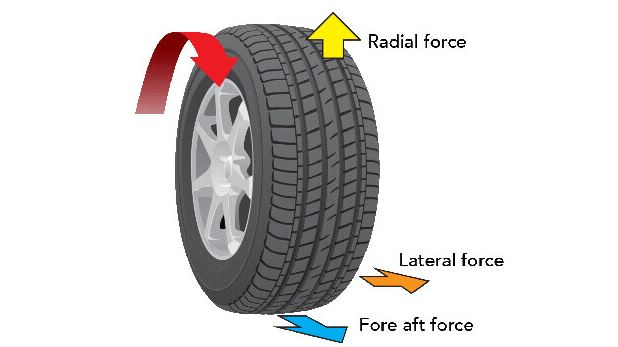
Tyre Stiffness (Radial Force Variation – RFV): This is the paramount issue. The multiple-ply construction and aggressive tread mean the tyre’s sidewall and tread area are not uniformly flexible. As the tyre rolls, stiff spots exert a pulse of greater force on the road than flexible spots. This repeated, subtle pulsing, known as Radial Force Variation (RFV), is the primary cause of sustained, speed-sensitive vibrations. Critically, RFV is a uniformity issue, not a weight issue, and thus cannot be corrected by adding static balance weights alone. Standard balancing only fixes mass imbalance; it doesn’t fix the shape or the stiffness variations, which are the main culprits in LT/AT vibration.
3. Road-Force Balancing: The Definitive Solution
Advanced Measurement: How Road Force Technology Works
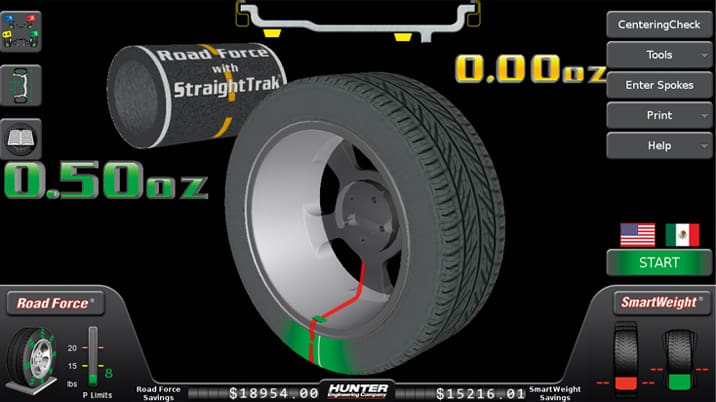
Road-force balancing is the essential evolution of wheel balancing technology designed specifically to address the structural and uniformity issues inherent in LT/AT tyres. It transforms the balancing process from a simple mass correction into a precision tuning procedure.
A road-force balancer, such as those made by industry leaders like Hunter, goes beyond traditional measurements by applying a hydraulic or pneumatic roller directly against the tyre, meticulously simulating the weight and load of the vehicle on the road surface. This roller applies a significant load, typically between 450 kg and 550 kg, replicating real-world driving conditions more accurately than any other method.
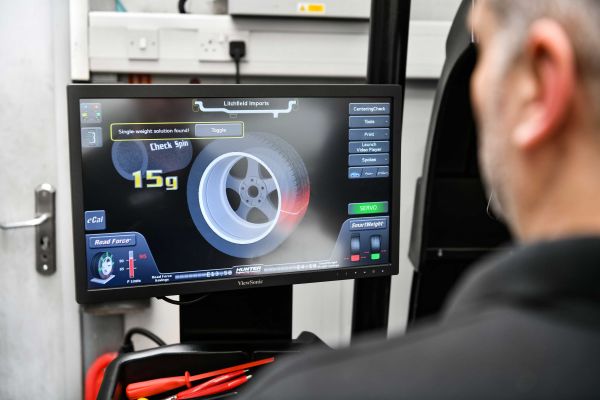
This dynamic testing allows the machine to perform the following critical steps:
- Simulated Load Application: The machine mounts the assembly and uses a roller to press against the tread, simulating the vehicle’s weight.
- Radial Force Variation (RFV) Measurement: As the assembly rotates under load, the machine measures the force exerted by the tyre. It identifies the high and low spots of stiffness, determining the total RFV value, which is the precise measurement of the tyre’s stiffness and roundness under load.
- Run-Out and Rim Measurement: Simultaneously, the machine precisely measures the lateral (side-to-side) and radial (up-and-down) run-out of the rim itself, identifying the rim’s lowest point (closest to the axle).
The Precision of Match-Mounting
The core benefit of road-force technology is not the balancing weights themselves, but the ability to perform a process called match-mounting.
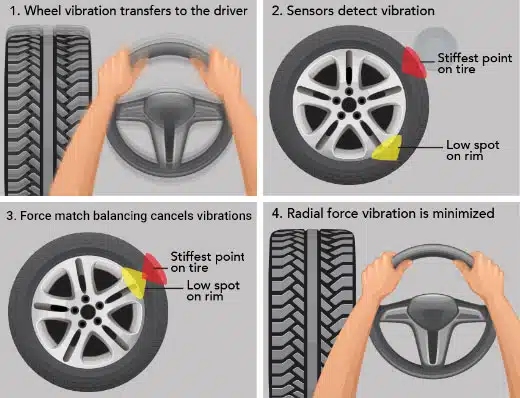
- Identification: The machine identifies the tyre’s stiffest point (peak RFV) and the wheel’s lowest point (lowest point of radial run-out).
- Alignment: The technician then dismounts the tyre, rotates it on the rim, and remounts it so that the stiffest point of the tyre is aligned precisely opposite the lowest point of the rim.
- Cancellation: By aligning the negative characteristic of the rim with the positive characteristic of the tyre, the machine effectively uses the rim’s natural imperfection to cancel out the tyre’s natural force variation. This dramatically reduces the overall RFV before any physical weights are even applied, often by 50 to 75 per cent.
After match-mounting, the residual mass imbalance is then corrected using traditional wheel weights, resulting in an assembly that is not only perfectly weighted but also rolls perfectly round under load—the only true way to achieve a vibration-free ride with heavy, stiff LT/AT tyres.
The LT/AT Imperative: Why Road Force is Essential
For serious 4×4 owners, road force balancing is not a luxury; it is a technical necessity. It addresses the fundamental design characteristics that standard balancers ignore.
- Addresses Structural Stiffness (RFV): AT tyres feature thick, multi-ply sidewalls and dense tread blocks for puncture resistance. This makes them stiffer than standard tyres, leading to greater Radial Force Variation (RFV). Road force balancing is the only method that can measure and correct this stiffness imbalance, eliminating the ‘lumpiness’ that causes vibration.
- Compensates for Tread Asymmetry: The aggressive, non-uniform tread patterns necessary for off-road grip inherently introduce structural and weight asymmetry that complicates traditional balancing. Road force technology handles the complex dynamic forces generated by these large, irregular tread blocks far more effectively.
- Mitigates Manufacturing Tolerances: Due to their rugged construction, AT tyres often have broader manufacturing tolerances for uniformity than highway tyres. Road force balancing measures and compensates for these minute differences in the tyre’s rotational force, preventing them from translating into noticeable vibration at cruising speed.
- Prevents Premature Suspension Wear: Uncorrected RFV causes constant, cyclical pounding on suspension and steering components (like ball joints, tie rods, and steering dampers). By smoothing out the rolling force, road force balancing significantly extends the lifespan of expensive, heavy-duty 4×4 suspension parts.
- Optimises for Sensitive 4×4 Steering: Many 4×4 vehicles, especially those with solid front axles or large lifts, are highly susceptible to steering wheel shudder or ‘death wobble’ caused by poor balance. Road force balancing delivers the maximum possible smoothness, which is critical for maintaining stability and control in these sensitive steering systems.
4. A Two-Tiered Strategy for Long-Term LT/AT Performance
Solving the vibration issue for high-performance off-road vehicles requires more than just a single visit to the mechanic; it requires a systematic, long-term approach using the correct technology.
Tier One: Precision Road Force Initial Fitment
Every new set of LT/AT tyres must undergo a road-force balancing procedure upon installation. This initial step is non-negotiable. Technicians must be instructed to perform the full match-mounting procedure to ensure the lowest possible Radial Force Variation (RFV) reading. This sets the foundation for a smooth ride from day one, mitigating the primary risk factors associated with stiff, non-uniform construction. Insist on seeing the printout showing the final RFV value; a lower number (e.g., under 15 lbs or 7 kg) correlates directly with a smoother ride.
Tier Two: Strategic Maintenance and Component Awareness
Given the aggressive nature of off-road driving—which can shift beads, introduce internal debris (like mud and grit), or cause uneven tread wear—the initial perfect balance will eventually degrade.
Maintenance Schedule:
- Regular Rotation: Tyres should be rotated according to the vehicle manufacturer’s schedule, typically every 8,000 to 10,000 km.
- Re-Balancing with Road Force: Crucially, a full LT/AT tyre balancing check using the road-force machine should be carried out whenever a significant vibration appears, or at least every second rotation. This ensures that any road damage or internal shifting of the tyre components is corrected before it causes catastrophic component wear. Simply adding more weight on a standard machine will only mask the problem and lead to accelerated wear.
Wheel Inspection and Integrity:
The overall balance is only as good as the weakest component. While the focus is often on the tyre, the wheel (rim) plays an equally vital role. Serious off-roading subjects rims to immense stress. Bent flanges from rock strikes or structural warping from aggressive cornering can introduce significant, permanent run-out that match-mounting can only partially compensate for. Before any re-balancing, the technician must inspect the rim visually and, ideally, use the road-force machine to specifically measure the rim’s run-out independently. If the rim’s run-out exceeds certain technical thresholds (often 0.05 inches or 1.27 mm), the wheel should be replaced, as no amount of balancing will fix a fundamentally deformed component.
Suspension and Steering Protection:
The most compelling argument for road-force balancing is component protection. Uncorrected RFV places a relentless, cyclical stress load on the vehicle’s suspension. This vibration translates directly into premature failure of:
- Steering Dampers: Designed to absorb high-frequency road input, constant RFV overloading quickly fatigues the damper oil and seals, leading to reduced effectiveness and allowing the shimmy to worsen.
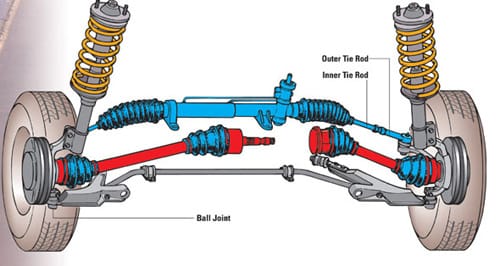
- Ball Joints and Tie Rod Ends: These components rely on precise tolerances and intact bushings. The constant pounding from an imbalanced wheel loosens these joints, creating play in the steering system that contributes to poor handling and dangerous instability.
In conclusion, for the serious 4×4 and overland enthusiast, the days of relying on antiquated balancing methods are over. Investing in a workshop that utilises road-force balancing technology is not merely a preference for comfort—it is a critical necessity for preserving vehicle components, ensuring safety, and guaranteeing performance on and off the asphalt. The minimal extra cost of this precision method is recouped many times over through extended tyre life, improved fuel economy, and the avoidance of premature suspension failure.