After years of speculation, discontinued nameplates, and a teasing campaign that tested the patience of four-wheel-drive enthusiasts worldwide, the legendary Mitsubishi Pajero has officially returned. Unveiled globally for the 2027 model year, this latest iteration makes a decisive break from the monocoque architecture of the fourth-generation model that exited showrooms in 2021.
Instead, Mitsubishi has taken the Pajero back to its hardcore roots. By adopting a heavy-duty ladder-frame chassis shared with the latest Triton, this new generation steps up as a bona fide flagship overlander designed to challenge segment heavyweights like the Toyota Land Cruiser Prado and Ford Everest.
Built for the Bush: Platform and Suspension
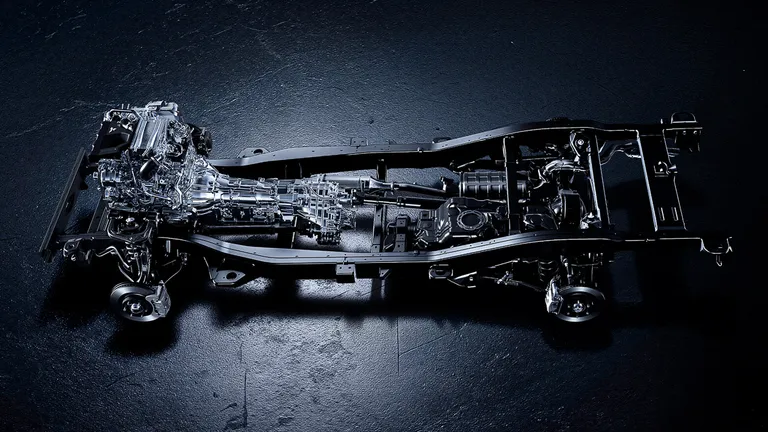
Purists can breathe a collective sigh of relief. Rather than following the automotive trend toward soft-roader unibody crossover construction, the 2027 Pajero is built on a modified version of the new Triton double-cab platform.

To ensure the Pajero delivers genuine off-road durability without sacrificing on-road composure or trail articulation, Mitsubishi did not merely drop an SUV body onto a bakkie frame. The ladder chassis has been comprehensively re-engineered:
- Chassis Rigidity: Upgraded with larger side members, bespoke front and rear sections, and additional cross-members to increase torsional stiffness.
- Lightweight Materials: High-tensile steel throughout the load-bearing structures reduces structural component weight by up to 50%, complemented by an aluminium bonnet to trim front-end mass.
- Suspension Overhaul: While the front features an independent double-wishbone setup engineered for higher lateral stiffness, the rear scraps the Triton’s utilitarian leaf springs entirely. In their place is a live rear axle supported by a sophisticated five-link coil-spring suspension, delivering superior wheel articulation on cross-axle ruts and dramatically improved bump absorption over severe corrugated tracks.
- Braking: Four-wheel ventilated disc brakes provide the stopping power necessary for heavily laden expedition rigs.
Off-Road Geometry and Footprint
Dimensionally, the 2027 Pajero has grown substantially, slotting right into the sweet spot between the Everest and the Prado:
| Metric | 2027 Mitsubishi Pajero | Outgoing Pajero Sport |
| Overall Length | 4,920 mm | 4,825 mm |
| Overall Width | 1,925 mm | 1,815 mm |
| Overall Height | 1,910 mm | 1,835 mm |
| Wheelbase | 2,870 mm | 2,800 mm |
| Ground Clearance | 230 mm | 218 mm |
| Approach Angle | 30.4° | 30.0° |
| Departure Angle | 25.8° | 24.2° |
| Breakover Angle | 22.6° | 24.2° |
| Turning Circle | 11.6 m | 11.2 m |
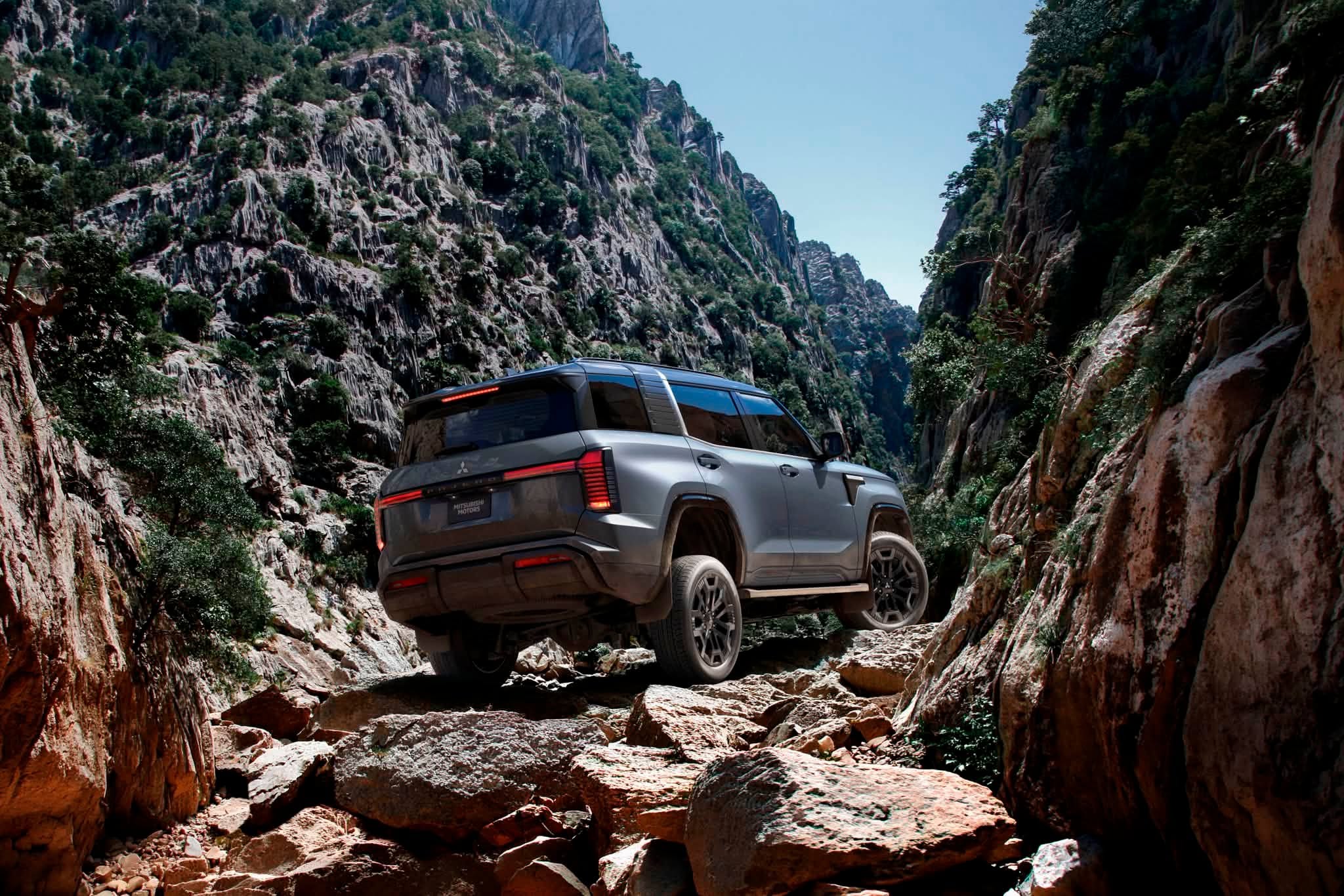
With 230 mm of ground clearance and tidy overhangs providing a 30.4° approach angle and a 25.8° departure angle, the vehicle is well-equipped to tackle steep technical climbs and boulder-strewn dry riverbeds straight off the showroom floor.

Powertrain: Proven 2.4-Litre Turbo-Diesel Muscle
Under the bonnet sits a revised version of Mitsubishi’s 2.4-litre ‘4N16’ four-cylinder turbo-diesel engine. While certain global iterations of the Triton deploy a twin-turbo arrangement, the new Pajero is equipped with a newly tuned single variable-geometry turbocharger (VGT).
Mitsubishi claims this single-turbo configuration delivers sharper off-the-mark throttle response and linear low-end pull:
- Maximum Power: 150 kW
- Peak Torque: 480 Nm
- Transmission: A newly developed eight-speed automatic gearbox (replacing the six-speed transmission found in the Triton).
The inclusion of an eight-speed automatic provides a wider spread of ratios. The lower first gear aids low-speed rock crawling and technical descents, while the taller overdrive eighth gear promises relaxed revs and better fuel economy when chewing through long, open-road transit sections. Braked towing capacity is expected to hit the class-benchmark 3,500 kg, making it ideal for hauling heavy-duty off-road caravans or bush trailers.
While larger V6 engines are off the table, Mitsubishi engineers have indicated that hybrid and plug-in hybrid (PHEV) powertrains are being actively evaluated for future additions to the lineup.
True Off-Road Arsenal: Super Select II and S-AWC
Mitsubishi’s greatest mechanical hallmark has always been its drivetrain adaptability, and the new Pajero carries this legacy forward with the latest evolution of the Super Select II 4WD system:
- 2H (Rear-Wheel Drive): Maximum efficiency on dry tarmac and everyday highway cruising.
- 4H (Full-Time Four-Wheel Drive): Unlike traditional part-time systems, 4H leaves the centre differential open, allowing drivers to engage all-wheel traction on sealed roads, wet asphalt, or fast gravel tracks without risk of driveline binding.
- 4HLc (Four-Wheel Drive High Range with Locked Centre Diff): Distributes drive evenly between the front and rear axles for deep sand, loose gravel, and mud.
- 4LLc (Four-Wheel Drive Low Range with Locked Centre Diff): Engages low-range crawler gears for steep, technical climbs, heavy mud, and rock crawling.
This mechanical backbone is augmented by Super-All Wheel Control (S-AWC) and Active Yaw Control (AYC), which monitor steering angle, yaw rate, and wheel speed to brake individual wheels and channel torque where it is needed most. Seven selectable drive modes – Normal, Eco, Gravel, Snow, Mud, Sand, and Rock – adjust throttle response, gearbox mapping, and traction control parameters, while a physical rear differential lock remains standard for the most demanding technical terrain.
Rugged Styling Meets Overlanding Tech
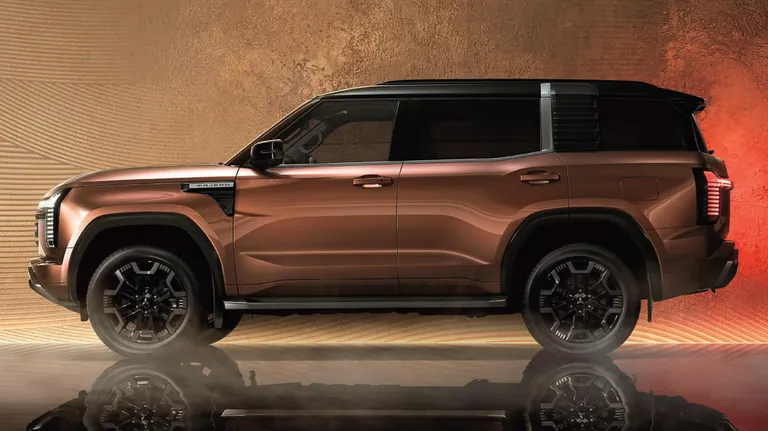
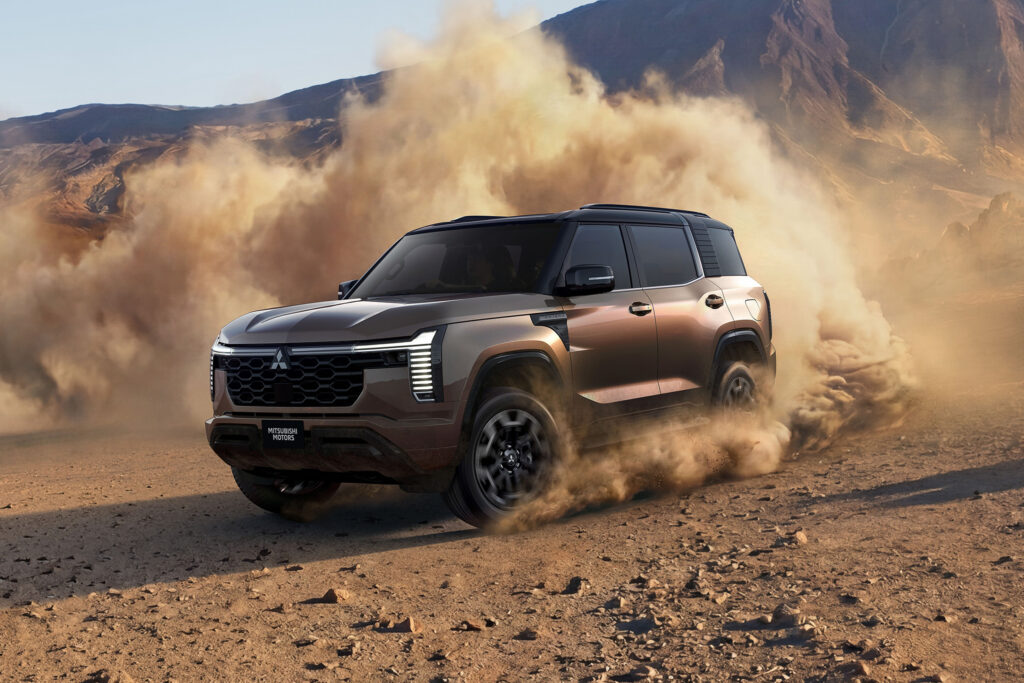
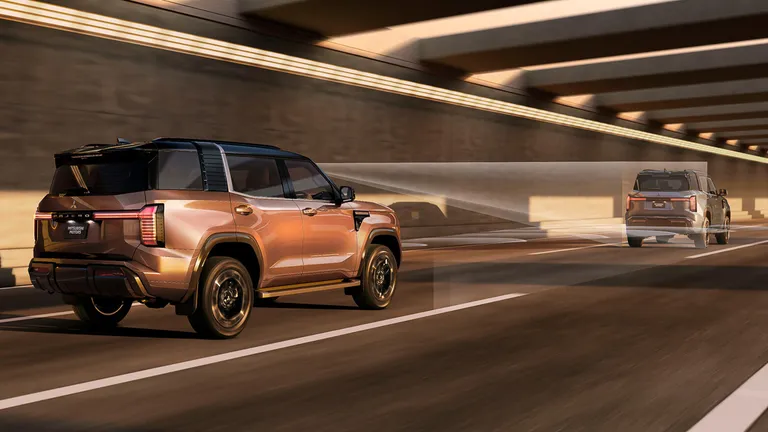
Visually, the 2027 Pajero discards the curvier lines of modern crossovers in favour of a chiseled, upright silhouette that echoes classic Pajero generations. Mitsubishi’s signature ‘Dynamic Shield’ design is pressed directly into the steel bodywork rather than relying on bolt-on plastic trim.
Smart practical details for the bush abound:
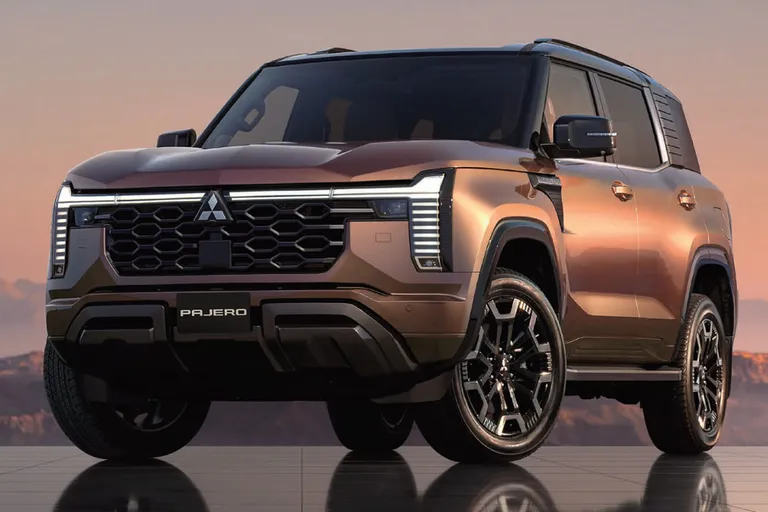
- The primary LED headlight clusters are mounted inboard, protected by the daytime running lights to reduce the chance of expensive damage from overhanging thorn trees on narrow bush tracks.
- The boxy roofline and near-vertical tailgate maximise interior volume and packing practicality.
- Full-width front and rear LED light signatures provide modern illumination during night stages.
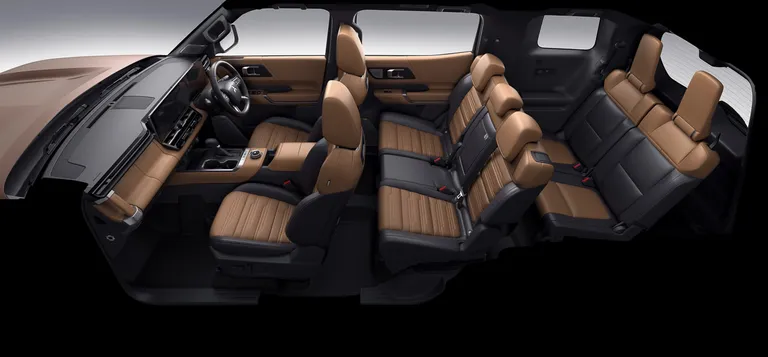
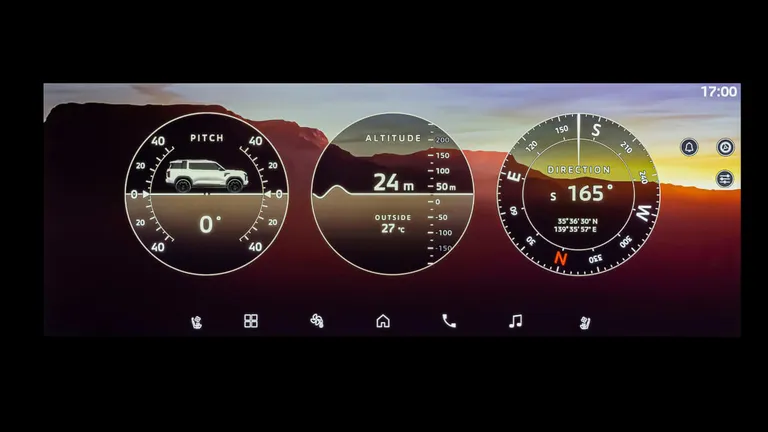
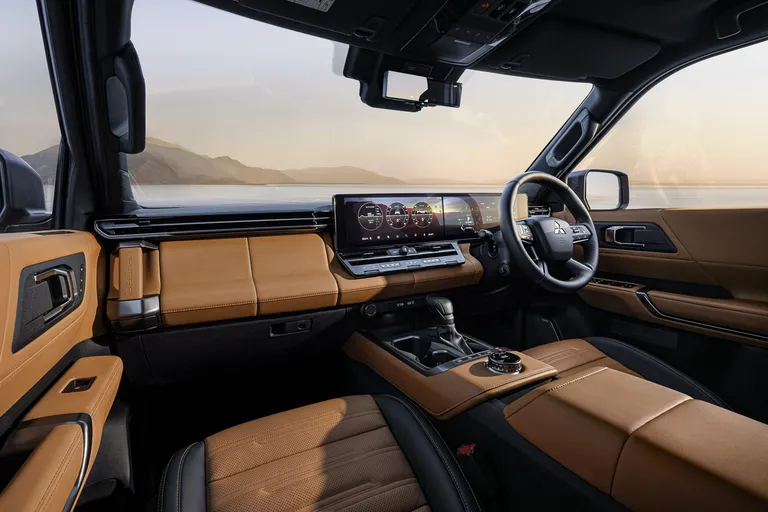
Inside, the cabin takes a notable leap upmarket to reflect its flagship status. Spanning three rows of seating, the cabin features premium leather upholstery, tri-zone climate control, and a panoramic sunroof on top-tier grades. The technology suite is headlined by twin 14.3-inch digital displays – one serving as a fully customisable digital instrument cluster, and the other managing infotainment, off-road telemetry, and surround-view cameras. Importantly, Mitsubishi has retained physical switchgear for climate controls and 4×4 engagement, a welcome touch when driving with dusty or gloved hands.
The Big Question: When Will South Africa See It?
For overlanding fans Down Under, the timeline is already locked in: Australian deliveries are scheduled to begin between October and December 2026, with four trim grades (GLX, GLS, Exceed, and GSR) replacing the Pajero Sport to battle the Ford Everest and Toyota Prado head-on.
What about South Africa?
At this stage, Mitsubishi Motors South Africa (MMSA) has not confirmed official dates for if or when the 2027 Pajero will touch down locally. However, Australia’s late-2026 arrival serves as an invaluable gauge.
South Africa and Australia share right-hand-drive assembly requirements, similar harsh trail conditions, and deeply intertwined automotive product planning. When a ladder-frame 4×4 lands Down Under, local introduction typically follows within six to twelve months. Given the immense local appetite for capable, seven-seater, ladder-frame adventure SUVs – and the expanding pricing void left between mid-tier bakkie-based SUVs and premium overland wagons – the 2027 Pajero makes supreme strategic sense for our market.
Should MMSA give it the green light, we could reasonably expect to see this legend arriving on South African shores during the course of 2027.