There is an undeniable magic to the words ‘Land Cruiser’. For more than70 years in South Africa, tha t singular badge has stood as a monument to rugged capability, engineering durability and the freedom to go wherever the road ends. It is a premium nameplate with legendary status.
To put its commercial strength into perspective, Toyota South Africa recently revealed that, if Land Cruiser were recorded as its own standalone entity in the premium sector, it would have comfortably attained the number two position behind BMW at the close of 2025. Now, with the official local introduction of the highly anticipated all-new Land Cruiser FJ, Toyota is looking to strengthen its position even further.
But let us clear up the nomenclature from the outset. This is the Land Cruiser FJ. It is explicitly not a successor to the FJ Cruiser. While the retro-cool FJ Cruiser of yesteryear was a styling icon, it was arguably never a true Land Cruiser under the skin in the traditional workhorse sense.
The new Land Cruiser FJ, however, is the real deal. It is an authentic ladder- frame invitation to explore further, designed specifically to bring the iconic Land Cruiser heritage to a new generation of overlanders.

Positioned for action: The competitive landscape
Slotting neatly into the fiercely competitive D-segment SUV market, the Land Cruiser FJ arrives as a dedicated 4×4 contender. The segment has seen significant transformation since 2020, with a major influx of monocoque premium competitors pushing prices into territory previously occupied by larger and more expensive vehicles.
Toyota’s multi-pronged strategy to compete in this space relies on a trio of distinct offerings: the family-oriented RAV4, the all-electric bZ4X and now the pure off-road specialist – the Land Cruiser FJ.
Priced at R714 000 for the entry-level GX grade and topping out at R761 000 for the high-specification model, the FJ occupies an interesting position in the market. It sits roughly R200 000 above a five-door Suzuki Jimny, making it a logical next step for adventurous families who have outgrown their compact rigs but still crave authentic off-road capability.
At the other end of the scale, it positions itself against Chinese lifestyle competitors such as the GWM Tank 300. While it is slightly pricier than some diesel Tank 300 derivatives, it is approximately R15 000 cheaper than comparable petrol models. Crucially, the FJ represents a significantly more affordable entry point into the prestigious Land Cruiser amily, which previously required a minimum investment of around R1 million for a Land Cruiser 70 Series.
Design and utility: Pure, boxy purpose
Visually, the Land Cruiser FJ is an impressive example of functional retro-modern design. It adopts the unapologetically boxy aesthetic pioneered by the new Prado, relying on straight lines and a purposeful stance. Importantly, this is not styling for the sake of appearances. Every aspect of the design serves a purpose.
Borrowing practical design philosophies from the Prado, the FJ features durable exterior materials and clever split bumpers at both the front and rear. If you misjudge a rock step or clip a stump out in the bush, damaged sections can be unbolted and replaced without the need for an entirely new bumper assembly.
The side profile reveals a relatively low beltline, which improves visibility around the vehicle when navigating technical terrain. Black roof rails come standard to accommodate additional luggage, while the rear design incorporates distinctive combination lamps and a uniquely engineered rear door.
South African buyers can choose from five exterior colours, selected according to global sales data from Toyota’s IMV range, including the striking introduction of an Ashtray Grey finish. Depending on specification level, the FJ rides on either 17-inch or 18-inch wheels, both fitted with highway-terrain tyres from the factory.
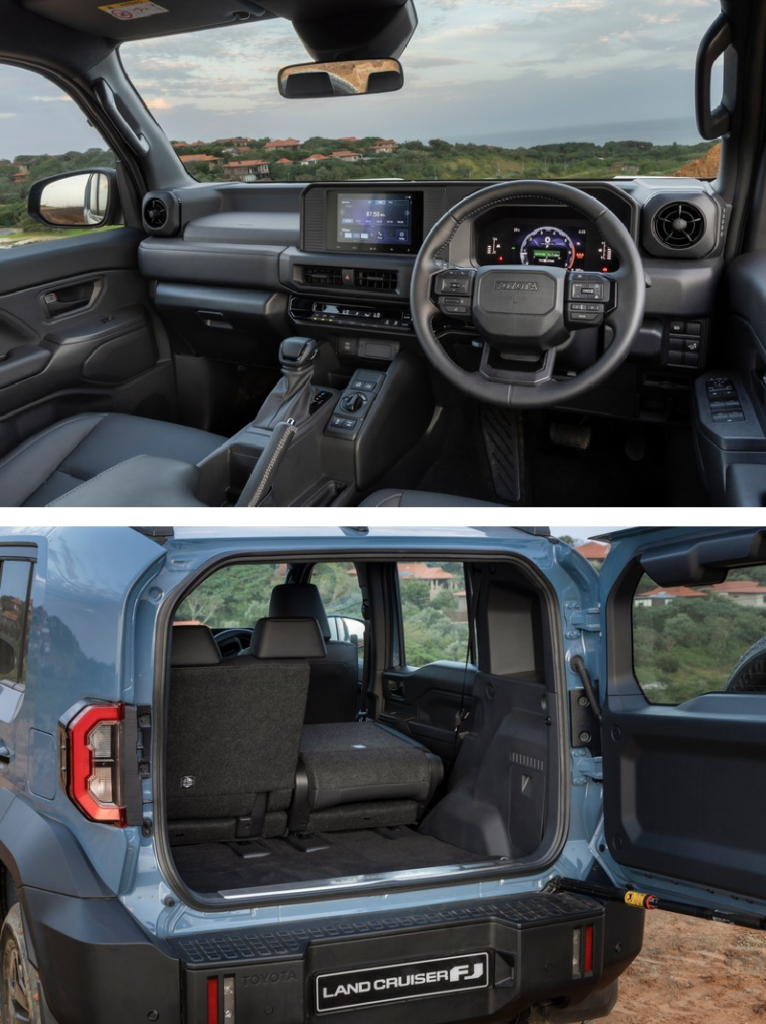
Inside, the cabin follows a wraparound design philosophy that balances practicality with quality materials. The predominantly black interior has been designed to cope with mud, dust and regular off-road use without sacrificing comfort. The GX model receives durable fabric seats, while the higher-grade version upgrades to partially synthetic leather upholstery. Apple CarPlay and Android Auto are both included via a wired connection, practical storage areas are positioned throughout the cabin and soft knee padding has been integrated into the centre console to provide additional comfort during demanding off-road manoeuvres.
Most importantly for traditionalists, Toyota has retained physical controls for the high- and low-range transfer case rather than burying critical functions within touchscreen menus.
Bulletproof DNA: The Hilux and Fortuner foundation
Underneath the eye-catching bodywork lies a chassis built around Toyota’s legendary QDR (Quality, Durability and Reliability) philosophy. Rather than utilising the newer GA-F platform found beneath the Land Cruiser 300 and Prado, the Land Cruiser FJ is built on a heavily modified version of the tried-and-tested F3 platform.
For the uninitiated, this is the ultra-robust ladder-frame architecture that underpins two of South Africa’s favourite workhorses: the Hilux and Fortuner. The silver structural elements beneath the body are carried over from the Fortuner, while the blue structural components are shared with the Hilux. By shortening the wheelbase, Toyota has created a highly agile platform that promises a distinctly different driving experience from its larger Land Cruiser siblings. Up front, the FJ employs a double-wishbone independent suspension setup, while the rear relies on the proven rigid live axle carried over from the Hilux range.
Despite its boxy proportions, Toyota has also paid close attention to aerodynamics while introducing extensive improvements to noise, vibration and harshness levels, resulting in a quieter and more refined cruising experience.
Powertrain: Old-school reliability over outright speed
Powering the Land Cruiser FJ globally is Toyota’s trusted 2.7-litre naturally aspirated petrol engine. In this latest application, incorporating both electronic and mechanical refinements from overseas Prado variants, the engine produces 120kW and 245Nm.
In a world increasingly dominated by small- capacity turbocharged engines, a naturally aspirated petrol-powered 4×4 offers a distinctly different driving experience. Throttle response is linear, power delivery is predictable and there is none of the sudden surge associated with turbocharged powerplants. What buyers are getting in return is peace of mind. This engine has earned a reputation for durability and its ability to cope with varying fuel quality. Developed during an era when fuel standards were not as consistent as they are today, it is particularly well suited to remote travel where fuel quality cannot always be guaranteed.
The trade-off, as expected, comes at the fuel pumps. With a brand-new engine on the clock, highway cruising at 110km/h is expected to return around 12.1 to 12.2 litres/100km. Venture into soft sand or spend a day tackling a technical 4×4 route and that figure can quickly climb beyond 15 litres/100km.
Combined with a relatively modest fuel tank that indicates a range of roughly 370km on a full tank, serious overlanders will need to plan accordingly. Whether that means carrying jerry cans or investing in an aftermarket long-range tank, additional fuel capacity is likely to become a priority for those venturing deep into Africa.
Trail weapon: Uncompromising off-road capability
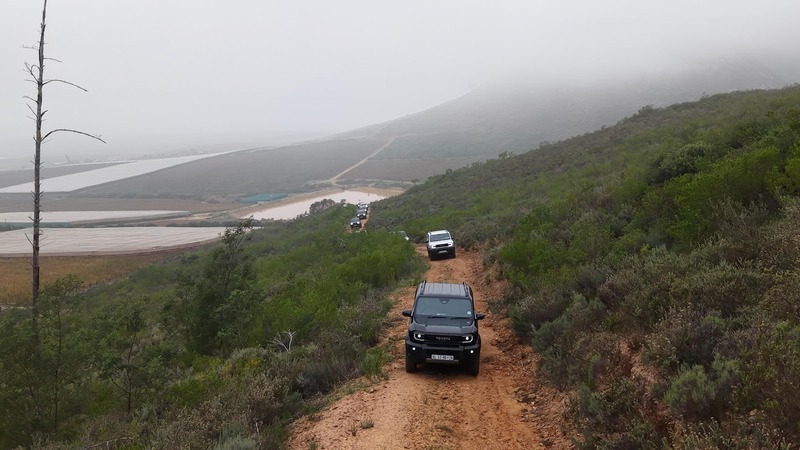
While its on-road manners are comfortable and reassuring, the Land Cruiser FJ’s primary purpose is to excel off the beaten track. This is not a soft-roader dressed up to look adventurous. It is a genuine off-road machine designed with capability as a priority.
It boasts impressive approach and departure angles, generous ground clearance and a compliant suspension setup that deals with washaways, ruts and cross-axle obstacles with ease. The mechanical package includes 4H, 4L and a selectable rear differential lock. What makes the FJ particularly impressive, however, is the way its electronic systems complement the traditional mechanical hardware.
The traction control system is exceptionally well calibrated. Even when tackling slippery clay slopes on standard highway-terrain tyres, the electronics are able to find traction quickly and effectively, allowing the vehicle to continue making forward progress without excessive wheelspin or drama.
Equally impressive is the revised downhill descent control system. Unlike some systems that hesitate before intervention, the FJ takes immediate control once activated.
On steep descents it maintains a steady 4km/h and, when conditions become even more challenging, reduces speed to around 3km/h. The system also allows for driver intervention. Apply the accelerator to negotiate an obstacle more quickly and, as soon as you lift off, the system smoothly resumes control without disengaging.
Safety, accessories and customisation
Despite its rugged character, Toyota has not overlooked modern safety requirements. The Land Cruiser FJ is equipped with the latest Toyota Safety Sense 3 suite, incorporating features such as lane keep assist, lane departure warning, blind-spot monitoring and seven airbags.
It also benefits from a panoramic view monitor and a dedicated off-road camera system, allowing drivers to see obstacles hidden directly in front of the vehicle when cresting hills or negotiating technical terrain.
Recognising that many owners enjoy personalising their vehicles, Toyota has partnered directly with respected off-road specialist ARB. Customers can visit dedicated lifestyle centres within Toyota dealerships and choose from a wide range of factory-backed accessories, including bull bars, suspension upgrades, recovery equipment and other overlanding essentials. For technology enthusiasts, a larger 12.3- inch display audio system is also available at an additional cost of approximately R12 000.
The verdict
Toyota appears to have listened carefully to what South African overlanders want from a modern off-road vehicle. The all-new Land Cruiser FJ is a capable and authentic addition to the Land Cruiser family, combining proven mechanical foundations with modern technology and safety features.
Built on a trusted Hilux and Fortuner-based platform, powered by a proven naturally aspirated petrol engine and equipped with genuine off-road hardware, it offers buyers a more accessible entry point into the Land Cruiser family.
Yes, fuel consumption is unlikely to impress, and many owners will probably add a long-range tank and more aggressive all-terrain tyres shortly after taking delivery. Even so, those compromises seem a small price to pay for a vehicle that remains true to the values that made the Land Cruiser name legendary in the first place. Expect to see plenty of them exploring South Africa’s back roads and beyond in the years to come.