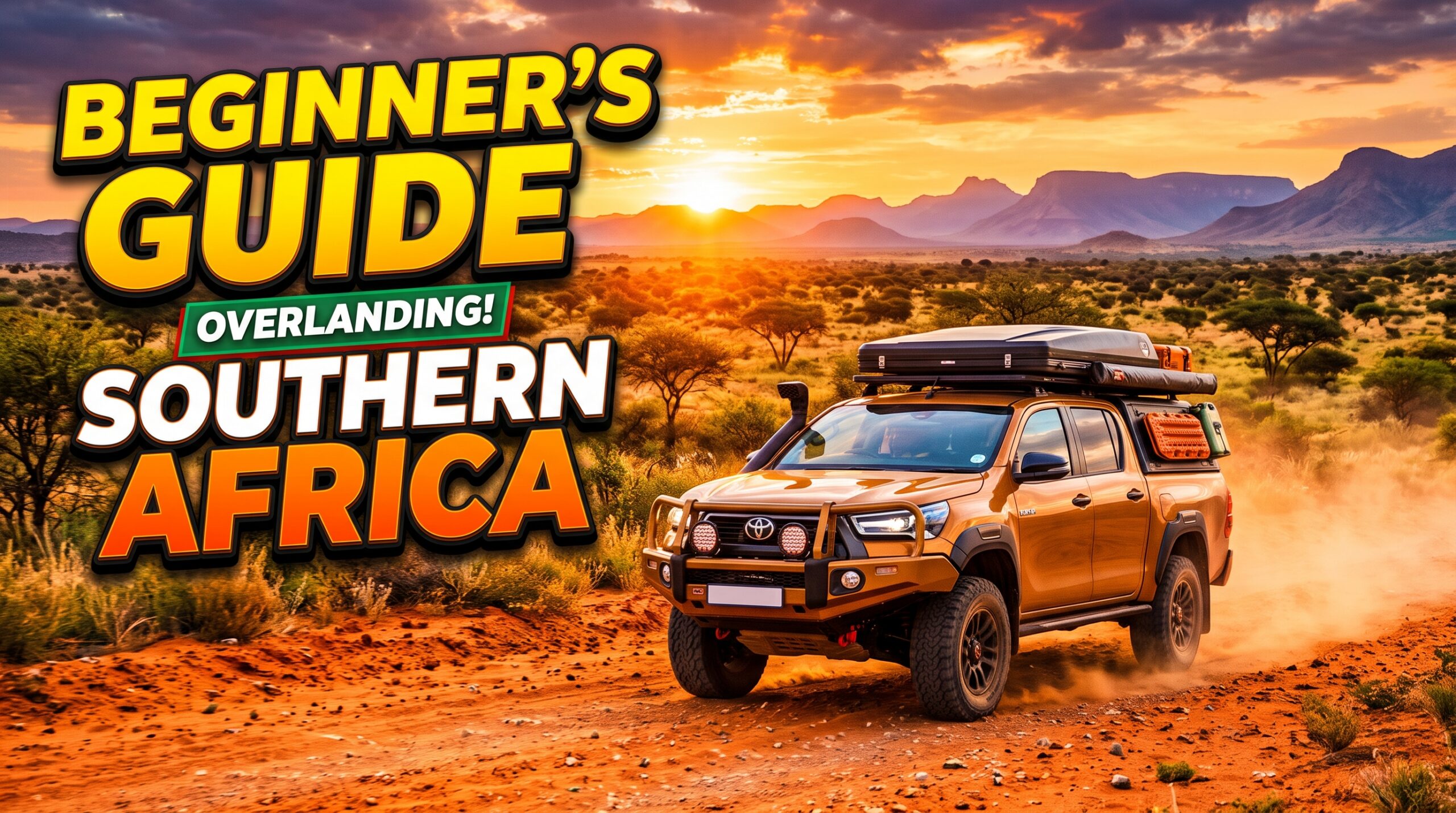
Few experiences match the thrill of pointing a rugged vehicle toward the horizon, leaving the tarmac behind, and driving straight into the wild expanses of Southern Africa. From the sweeping gravel highways of Namibia and the red dunes of the Kalahari to the wildlife corridors of Botswana and the rocky escarpments of Lesotho, overland travel represents self-drive exploration at its finest.

Yet for newcomers, the online forums can make overland expeditions sound intimidating, demanding bespoke expedition trucks, complex mechanical mastery, and endless specialist equipment.
The practical reality is far simpler: most iconic Southern African routes require thoughtful preparation, disciplined driving habits, and an understanding of vehicle capabilities rather than a purpose-built safari truck. This guide cuts through the forum folklore to explain what overland travel actually entails across the subcontinent, when low range is truly non-negotiable, how different terrains treat your vehicle, and how to structure a realistic, stress-free maiden journey.
1. What Overlanding Means in Southern Africa

On a conventional road trip, the journey revolves around the destinations you link together—cruising on sealed tarmac between towns, stopping at convenience stores, and checking into a guesthouse or lodge each evening. You are rarely more than an hour away from roadside assistance, cellular coverage, a fuel pump, or a supermarket.
Overland travel shifts that focus entirely. The driving itself forms the core of the expedition, and self-reliance dictates your daily decisions. Out on regional gravel routes and remote transit tracks:
- Distance is measured in tank range, hours, and daylight, rather than straight-line kilometres.
- Settlements with reliable fuel and fresh water can sit 300 km to 500 km apart.
- Wild and remote campsites require complete autonomy, meaning you must carry your own drinking water, food provisions, off-grid power, cooking setup, and shade.
- Crossing borders adds procedural complexity, requiring your vehicle’s ownership documents, cross-border insurance clearances, and strict biosecurity compliance.
- Mechanical hiccups and punctures are yours to resolve, requiring functional recovery gear, basic trailside tools, and a reliable secondary communication plan.
Southern Africa has the well-maintained gravel networks, transfrontier parks, and established infrastructure to make this transition manageable for any careful driver.
2. Choosing the Right Vehicle: High-Clearance 2×4 vs 4×4 with Low Range
A common myth is that every overland adventure requires a heavily kitted, twin-diff-lock 4×4 rig. The truth is more nuanced: much of Southern Africa’s most famous wilderness scenery is accessible via well-maintained district gravel roads, while specific sandy tracks and mountain ascents strictly demand low range and genuine off-road capability.

Where a High-Clearance 2×4 Excels
Equipped with sturdy All-Terrain (A/T) tyres and sensible ground clearance (200 mm or more), a two-wheel-drive bakkie or compact SUV handles:
- Namibia’s major C- and D-designated gravel arteries (including the classic Windhoek, Sesriem/Sossusvlei, Swakopmund, and Damaraland circuit).
- The primary tourist road networks in South African national parks like Kruger, Addo Elephant, and Pilanesberg.
- Secondary district gravel roads traversing the Great Karoo, Tankwa Karoo, and Northern Cape.
Where a True 4×4 with Low Range Is Non-Negotiable
You must have a four-wheel-drive vehicle equipped with a dedicated low-range transfer case and proper recovery mounting points when heading to:
- Botswana’s Northern Parks: The deep, thick sand two-tracks of Moremi Game Reserve, Savuti, Khwai, and Chobe riverfront tracks.
- Salt Pans: The Makgadikgadi and Nxai Pan networks, where deceptively dry crusts conceal bottomless, tyre-swallowing mud beneath.
- High-Altitude Passes: Sani Pass ascending into Lesotho from KwaZulu-Natal, where border control officials on the South African side enforce a strict 4×4-only rule.
- Remote Coastal Sand: Mozambique’s sandy coastal tracks around Ponta do Ouro or north toward Vilanculos.
- Unpaved routes after heavy rainfall, where clay-rich surfaces quickly transform into impassable mud traps.
Renting vs Equipping Your Own Rig
For beginners, hiring a fully outfitted expedition double-cab bakkie (such as a Toyota Hilux 2.4/2.8 GD-6 or Ford Ranger) represents the smartest entry point.
Rental units generally arrive equipped with:
- Rooftop tent or clam-shell setup
- 12V auxiliary dual-battery system and compressor fridge/freezer
- Full camp kitchen, water tanks, recovery tracks, and 12V tyre inflator
Off-season rental rates generally range from R2,000 to R2,500 per day on multi-week hires, while peak dry-season rentals (July to August) range between R3,500 and R4,500 per day. Renting allows you to road-test different camping layouts and storage systems before investing hundreds of thousands of rands in custom drawers, canopies, and suspension upgrades.
3. How Gravel, Corrugations, and Sand Affect Your Rig
Understanding the physical dynamics of off-tar driving preserves your chassis, safeguards your suspension, and keeps your vehicle firmly under control.
Gravel: Managing Braking Distance and Momentum
Gravel functions like thousands of microscopic ball bearings rolling beneath your tread blocks. It substantially lengthens braking distances, diminishes lateral steering response, and reduces overall tyre grip.
- Maintain disciplined road speed: An indicated 80 km/h on a dry, straight gravel road feels relaxed, but it is already brisk.
- Anticipate terrain transitions: Washaways, blind rises, dry river drifts (laagtes), and cattle grids require early, progressive deceleration. Never slam on brakes mid-turn or on sudden loose marbles.
Corrugations: The Real Vehicle Breaker
Corrugations are the transverse washboard ridges carved into graded gravel roads by heavy axle oscillation and acceleration chop. Contrary to popular trail banter, accelerating to high speeds to “skim” across the ridges is a dangerous gamble: your tyres lose consistent surface contact, drastically reducing steering and braking performance.
Severe vibration shakes bolts loose, degrades damping fluid in shock absorbers, cracks roof-rack welds, and fractures canopy mountings. Make it a daily ritual to inspect:
- Wheel lug nuts
- Roof-rack anchor bolts
- Dual-battery tie-downs
- Spare wheel brackets and jerry-can mounts
Deep Sand: A Matter of Technique, Not Pure Horsepower
Driving successfully through deep sand relies on low tyre pressures and steady momentum—not raw engine power. Flooring the accelerator spins the wheels, clears the loose sand from under the tread, and instantly digs the axles down onto the belly plates.
- Select your 4WD gear range (4H or 4L) before driving into soft sand.
- Carry consistent forward momentum without aggressive revving.
- Anticipate your track and stay in existing ruts.
- Never brake abruptly in thick sand—lift off the accelerator smoothly and allow rolling resistance to bring you to a halt on level or downward-sloping ground.
- Sand heats up rapidly during midday, becoming loose and power-sapping. Plan your toughest sandy trail legs for early morning when the surface sand remains cool and relatively compacted.
4. Tyres, Operating Pressures, and the Two-Spare Philosophy
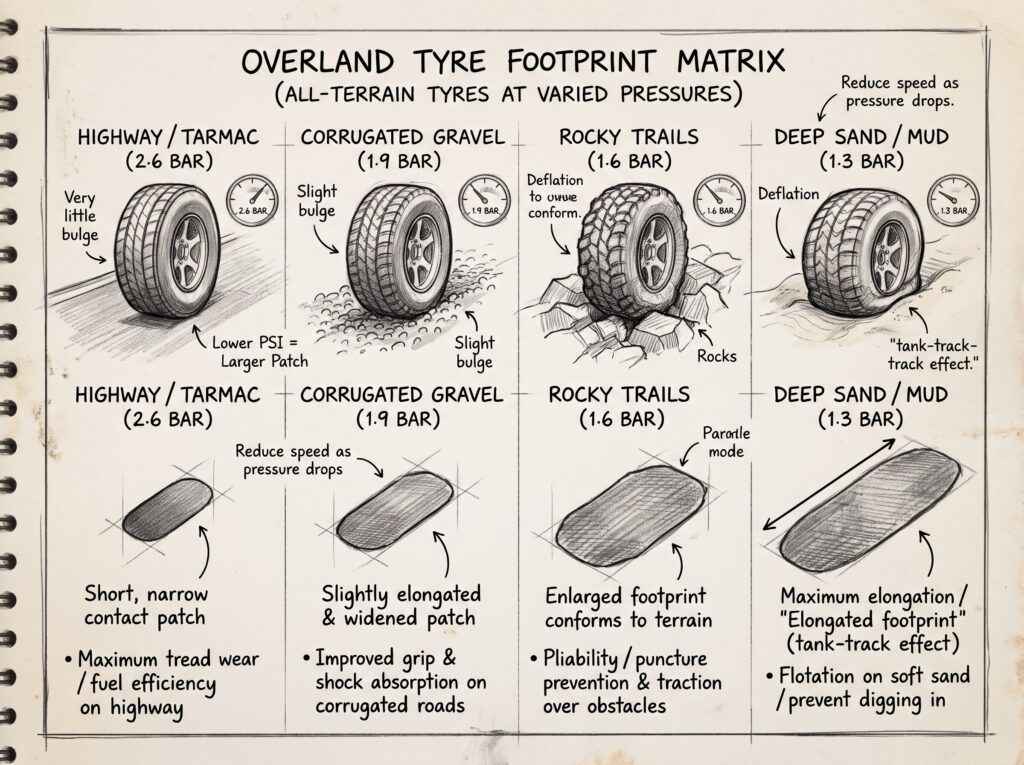
Tyres represent your single most critical piece of overland equipment. Standard highway passenger tyres lack the multi-ply sidewall construction required to endure Southern African gravel.
Why You Need Two Spare Tyres in Remote Regions
Sharp, irregular gravel shale does not cause simple slow punctures that can be addressed with an ordinary tubeless repair plug; it causes severe sidewall slashes and carcass failures.
Carrying two spare wheels mounted on matching rims is essential insurance:
- Spare #1 replaces your primary shredded tyre trailside.
- Spare #2 preserves your safety cushion while you drive the remaining 300 km to 500 km across remote corridors to reach a regional tyre fitment centre.
Always pack a heavy-duty tubeless tyre puncture plug kit, valve tools, a reliable digital tyre pressure gauge, and a high-volume 12V portable air compressor.
Re-inflation Rule: Deflating your tyres lengthens their footprint across sand, but running soft tyres at highway speeds causes heat build-up that destroys the casing. Always hook up your compressor and pump tyres back up to tarmac pressures the moment you return to sealed roads.
5. Trail Recovery Essentials: Keep It Simple and Safe
Getting bogged down in soft sand or loose gravel is an ordinary part of off-road travel. Seasoned overlanders handle recoveries calmly by sticking to simple recovery protocols:
- Stop Instantly: The second forward momentum ceases and your wheels spin without purchase, take your foot off the accelerator. Spinning your tyres digs the vehicle to its diffs in seconds.
- Clear the Sand: Step out and inspect your clearance. Use a sturdy long-handled shovel to clear sand from in front of all four tyres and scoop out mounds dragging under the differentials.
- Drop Tyre Pressures: If you entered the sand at 1.8 bar, drop the tyres down to 1.3 or 1.2 bar to widen the footprint. This alone frees many stranded rigs.
- Deploy Traction Boards: Place heavy-duty recovery boards (such as MAXTRAX or similar tracks) flat and snug against your leading tyres. In low-range first or second gear, crawl forward onto the tracks with smooth throttle input.
- Rig Recoveries Safely: When snatching or winching with a second vehicle, use only rated recovery points securely bolted directly to the chassis. Never hook a kinetic snatch rope or tow strap over a standard tow ball—a shearing tow ball turns into a lethal steel projectile. Always place a recovery damper blanket or heavy canvas bag across the centre of the recovery strap to suppress kinetic recoil in case of hardware failure.
6. Managing Water, Fuel Range, and Provisioning
Running dry in the bush is dangerous. Self-sufficiency requires calculating resource reserves with generous safety margins.
Calculating Fuel Range
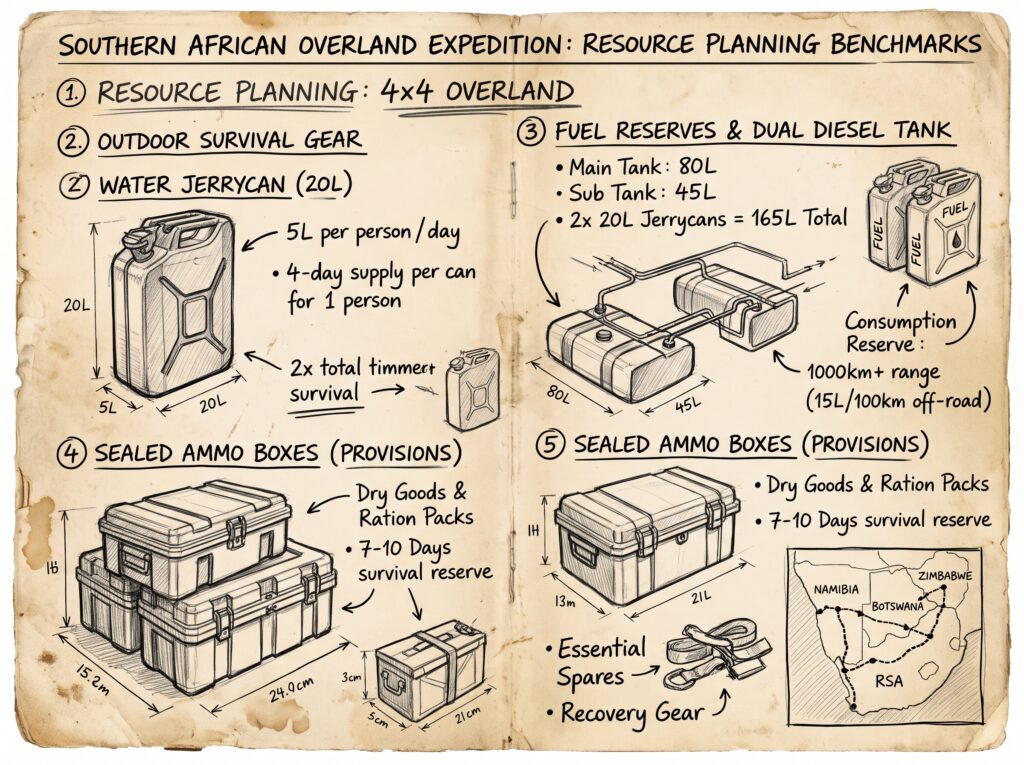
A fully loaded 4×4 double-cab laden with rooftop tents, dual water tanks, steel bumpers, and recovery gear that delivers 10 L/100 km on open highways will easily consume 14 to 18 L/100 km on corrugated gravel – and can surge past 22 L/100 km when grinding through deep, soft sand tracks in low range.
- Plan fuel by usable tank range, not simple map distances.
- Carry auxiliary fuel in chassis-mounted long-range tanks or rated steel/Poynting jerry cans safely secured in exterior brackets.
- Treat remote fuel stops (such as Nata, Kang, or Shakawe) as essential top-up points: fill your tank whenever you pass a functioning pump, regardless of your fuel gauge reading.
Potable Water Management
Budget a minimum of 5 litres of potable drinking and cooking water per person per day, with an extra 48-hour reserve margin for remote legs. Store drinking water in dedicated food-grade poly tanks or heavy-duty containers kept separate from washing or grey water.
Provisioning and Veterinary Red Lines
- Botswana Cordon Fences: Veterinary control fences run across Botswana to prevent the transmission of Foot-and-Mouth Disease (FMD) from wild buffalo herds to domestic beef cattle.
- The Golden Rule: You generally cannot transport fresh, raw red meat or cloven-hoofed game meat across veterinary cordon gates when travelling from North to South or East to West (e.g., passing south through Makalamabedi gate or leaving the Ngamiland district). Canned meats and thoroughly pre-cooked meals cross freely.
- Border Restrictions: Do not attempt to take fresh meat, raw poultry, or unpasteurised dairy across international border posts from South Africa into Botswana or Namibia during active biosecurity alerts. Always purchase fresh meat supplies locally at major transit hubs such as Maun, Kasane, Gaborone, or Windhoek.
7. Accommodation: Serviced Rest Camps vs Unfenced Wild Bush Camps
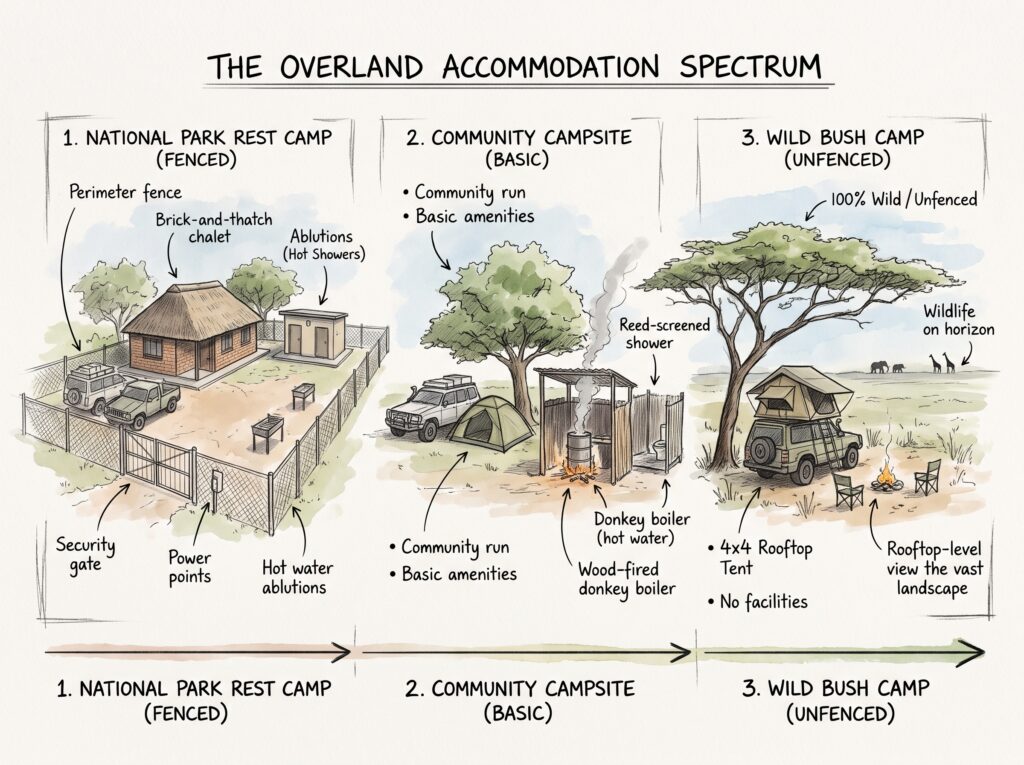
Overlanding does not require wild bush camping every single night. A balanced expedition itinerary mixes different accommodation styles to prevent crew fatigue.
The Starter Strategy
For your initial trips, prioritize fully serviced rest camps. Pitching and breaking down a rooftop tent or ground setup in the dark after eight grueling hours behind the wheel is how beginner overlanders burn out.
Starting in fenced rest camps provides hot showers, shaded sites, and camp stores. You can fine-tune your packing systems, verify your dual-battery setup, and confirm which gear works well before venturing into unfenced wilderness zones where lions and elephants roam freely through your campsite.
8. Cross-Border Paperwork and Port-of-Entry Formalities
Border crossings in Southern Africa run smoothly when you understand vehicle documentation requirements.
Essential Vehicle Paperwork Portfolio
Always compile your essential vehicle documents inside a clear, durable document folder:
- Vehicle Registration Document: Original or certified copy of your vehicle’s Certificate of Registration (NATIS logbook).
- Cross-Border Authorization Letter: If the vehicle is financed by a bank, leased, company-owned, or rented, you must present a signed and stamped letter from the registered owner granting permission for the vehicle to enter specific countries for specified dates.
- Cross-Border Insurance Letter: Written confirmation from your insurer affirming that comprehensive motor collision and theft cover extends to the destination countries.
- Valid Driving Licence & IDP: A current South African card licence (or SADC equivalent). An International Driving Permit (IDP) is recommended if your licence is in any language other than English.
- SARS TMS Pre-Declaration: For South African border crossings, complete the online South African Revenue Service (SARS) Traveller Management System declarations where applicable. High-value equipment (satellite phones, professional cameras, drones) should be declared on a customs Form DA65 or TC-01 prior to departure.
Vehicle Entry Fees and Road Levies
Expect the following baseline statutory fees when crossing regional borders in a private 4×4:
- Botswana: National Road Safety Fund (P40), Road Transport Permit, and Motor Vehicle Accident (MVA) fund levy (totalling roughly P150–P250).
- Namibia: Road Fund Administration (RFA) Cross-Border Road User Charge (gazetted at N$534 for standard passenger cars and 4×4 bakkies, plus N$340 for an off-road trailer or caravan).
- Eswatini: Road Safety Fund levy (approx. E150 / R150 per light motor vehicle).
- Lesotho: Road Toll Entry Levy (typically R30 to R50).
- Zimbabwe: Temporary Import Permit (TIP) processing, carbon tax, compulsory local third-party insurance, and road access fees (totalling approx. US$50 to US$80, plus infrastructure bridge tolls at Beitbridge).
9. Three Sensible First-Time Overland Itineraries
Avoid making your maiden overlanding trip an extreme deep-sand marathon across the Okavango Delta. Build trail confidence and test your equipment on these proven beginner routes:
Option A: The Classic Namibian Central-Southern Loop
- Route: Windhoek → Sesriem (Sossusvlei dunes) → Swakopmund → Spitzkoppe → Erongo Mountains → Windhoek.
- Duration: 8 to 10 days (approx. 1,400 km).
- Terrain: 70% wide gravel highways (C- and D-roads), 30% tarmac.
- Why It Works: Straightforward driving conditions, dramatic desert landscapes, accessible towns for restocking, and campsites with reliable infrastructure. Can be completed in a high-clearance 2×4 bakkie with quality tyres.
Option B: Kgalagadi Transfrontier Park (South African Sector)
- Route: Upington → Twee Rivieren → Nossob → Mata-Mata → Twee Rivieren.
- Duration: 6 to 8 days (approx. 900–1,100 km).
- Terrain: Corrugated gravel and maintained red-sand calcrete routes.
- Why It Works: Offers a wild safari atmosphere with abundant predator activity, while keeping you inside fenced rest camps featuring fuel pumps, basic grocery shops, and shaded stands. Requires 4WD for handling dune corrugations comfortably.
Option C: Northern Kruger and the Limpopo River Valley
- Route: Phalaborwa Gate → Letaba → Shingwedzi → Punda Maria → Pafuri / Makuleke Concession.
- Duration: 5 to 7 days (approx. 700–900 km).
- Terrain: Paved park roads mixed with low-speed gravel loops.
- Why It Works: Highly scenic, remote lowveld safari touring with well-appointed SANParks rest camp infrastructure every evening. Excellent for testing cooking setups, camping routines, and off-grid fridge efficiency in sub-tropical heat.
10. Estimated Budget for a Maiden Overlanding Trip
To assist in planning a two-week maiden overland expedition for two adults (self-catering in a self-drive rig), practical cost benchmarks break down as follows:

Frequently Asked Questions
Do I genuinely need a 4×4 to overland in Southern Africa?
Not always. A high-clearance 2×4 bakkie or compact SUV fitted with quality all-terrain tyres handles Namibia’s main gravel highways, SANParks tourist routes, and the arid roads of the Karoo. A dedicated 4×4 with low range is required only when tackling deep sand routes (such as Moremi and Savuti), salt pans, rocky mountain tracks (like Sani Pass), or muddy regional trails after rain.
What is the single biggest mistake first-time overlanders make?
Trying to cover too many kilometres in a single day. Long distances on corrugated gravel are physically exhausting. Limit driving stretches to 250–350 km per day, arrive at camp by mid-afternoon, and spend at least two consecutive nights at each key destination to actually enjoy the wilderness.
What tyre pressure should I run on corrugated gravel?
Lower your tarmac pressure down to approximately 1.8 to 2.0 bar (cold). This allows the tyre carcass to flex over sharp stones and washboard corrugations, significantly cushioning the ride, protecting the suspension, and reducing the risk of tread cuts.
Can I bring fresh meat and groceries from South Africa into Botswana?
Fresh beef, mutton, pork, and unpasteurised milk products are prohibited from cross-border entry during Foot-and-Mouth Disease biosecurity alerts. Plan to purchase your fresh meats and produce at butcheries and grocery stores in major hub towns like Gaborone, Francistown, Maun, or Kasane once you clear the border.