If you’ve ever driven Sani Pass, you’ll know that it’s not the sort of place that tolerates weakness – from vehicles or drivers. Rising through the mighty Drakensberg and connecting South Africa with Lesotho, the legendary mountain pass is a punishing mix of loose rock, steep switchbacks, and thin air. It’s where tyres bite, gears grind, and only the most capable machines earn bragging rights.
And now, for the first time ever, an all-electric vehicle has joined that exclusive club.
Volvo Car South Africa has officially written its name into the history books with the EX30 Cross Country becoming the first battery electric vehicle (BEV) to successfully conquer Sani Pass. It’s a feat that not only demonstrates the EX30’s capability but also signals how far electric mobility has come – from silent city commutes to the rocky, rutted wilderness of one of Africa’s toughest mountain trails.

A route steeped in history

Long before the first engines echoed across these mountains, Basotho shepherds braved the same rugged slopes on foot, herding livestock and trading goods across treacherous terrain. When the first vehicles attempted the climb decades later, it became a proving ground for endurance and engineering. Interestingly, it was back in 1969 that a Volvo first made it to the top – a feat that helped cement the brand’s reputation for toughness and reliability.
Fast-forward 56 years, and the spirit of adventure lives on, though this time it’s fuelled by electrons rather than petrol. The EX30 Cross Country’s ascent is more than just a demonstration of torque and traction – it’s a celebration of progress, of how technology can evolve without losing its sense of adventure.

The little powerhouse that could
Compact, tough, and rather good-looking, the Volvo EX30 Cross Country is proof that dynamite really does come in small packages. Beneath its Scandinavian design and minimalist cabin beats a 315kW electric heart, pushing out a formidable 543Nm of torque – all delivered instantly, as only an EV can. That means no lag, no gear changes, and no hesitation when the trail points skyward.
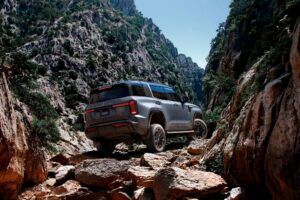
With all-wheel drive and a raised ride height, the EX30 Cross Country was more than ready to tackle the steep gradients and hairpin bends of Sani Pass. According to those who witnessed the climb, the little Volvo handled the notorious rocky sections with calm composure, maintaining traction and poise where many combustion-powered SUVs have been humbled. It wasn’t just a technical exercise – it was a statement that adventure and sustainability can co-exist quite happily.
Powering adventure, sustainably
Adding another layer of symbolism to the achievement was the installation of South Africa’s highest solar-powered EV charger. Located at Premier Resort Sani Pass at an altitude of 1 566m, the charger – installed by local renewable energy company CHARGE – made this journey a fully solar-to-solar expedition.
In other words, clean energy not only powered the EX30 up the mountain but also recharged it using the sun’s own energy harvested right there in the Drakensberg. The initiative underscores Volvo’s and CHARGE’s shared vision of sustainable adventure – exploring wild, remote places without leaving a heavy carbon footprint behind.

CHARGE founder Joubert Roux called it “a milestone in South Africa’s electric transition,” noting that the charger will be upgraded in 2026 to include battery backup for overnight use. It’s the kind of infrastructure development that makes the future of EV travel in remote areas look not just possible, but practical.
A defining moment for electric mobility
Volvo Car South Africa’s Managing Director, Grant Locke, described the Sani Pass climb as a defining moment for the brand and for the country’s electric journey. He pointed out that Sani Pass has always been a proving ground for determination and ingenuity – from the Willys Jeeps of the mid-20th century to the endurance trials that followed. By successfully sending an electric SUV up this infamous route, Volvo has now bridged decades of motoring evolution, combining capability with sustainability in a way that redefines what’s possible.
Locke also highlighted how the achievement reflects Volvo’s core philosophy: pushing boundaries while protecting the planet. “The EX30 Cross Country’s ascent shows that adventure no longer needs to come at the expense of the environment,” he said. “It’s a glimpse into a cleaner, more exciting future for South African motorists.”
Beyond the climb
For Volvo, this isn’t just a one-off stunt. It’s a continuation of the brand’s ongoing commitment to electrification and innovation. The EX30 itself has already turned heads since its global reveal – not only as the smallest and most affordable Volvo EV, but as one of the most powerful in its class.

With a range of up to 480km, blistering acceleration (0–100km/h in just 3.6 seconds), and that unmistakable Scandinavian flair for design, it manages to blend urban practicality with genuine off-road capability. And now that it has Sani Pass on its résumé, the EX30 Cross Country can proudly claim to be an EV that doesn’t just talk adventure – it lives it. As the dust settles on the trail and the last rays of the Drakensberg sun catch the EX30’s clean lines, one thing is certain: the future of exploration is electric. And thanks to Volvo’s bold little SUV, the once-unthinkable idea of an electric vehicle tackling Africa’s toughest terrain has become a very real – and very inspiring – reality.